Person SchemaDoctor CredentialsAI Visibility IndiaTechnical Guide
Your Surgeon Has 25 Years of Experience and Three Fellowships. ChatGPT Has No Idea. The Person Schema Problem in Indian Healthcare.
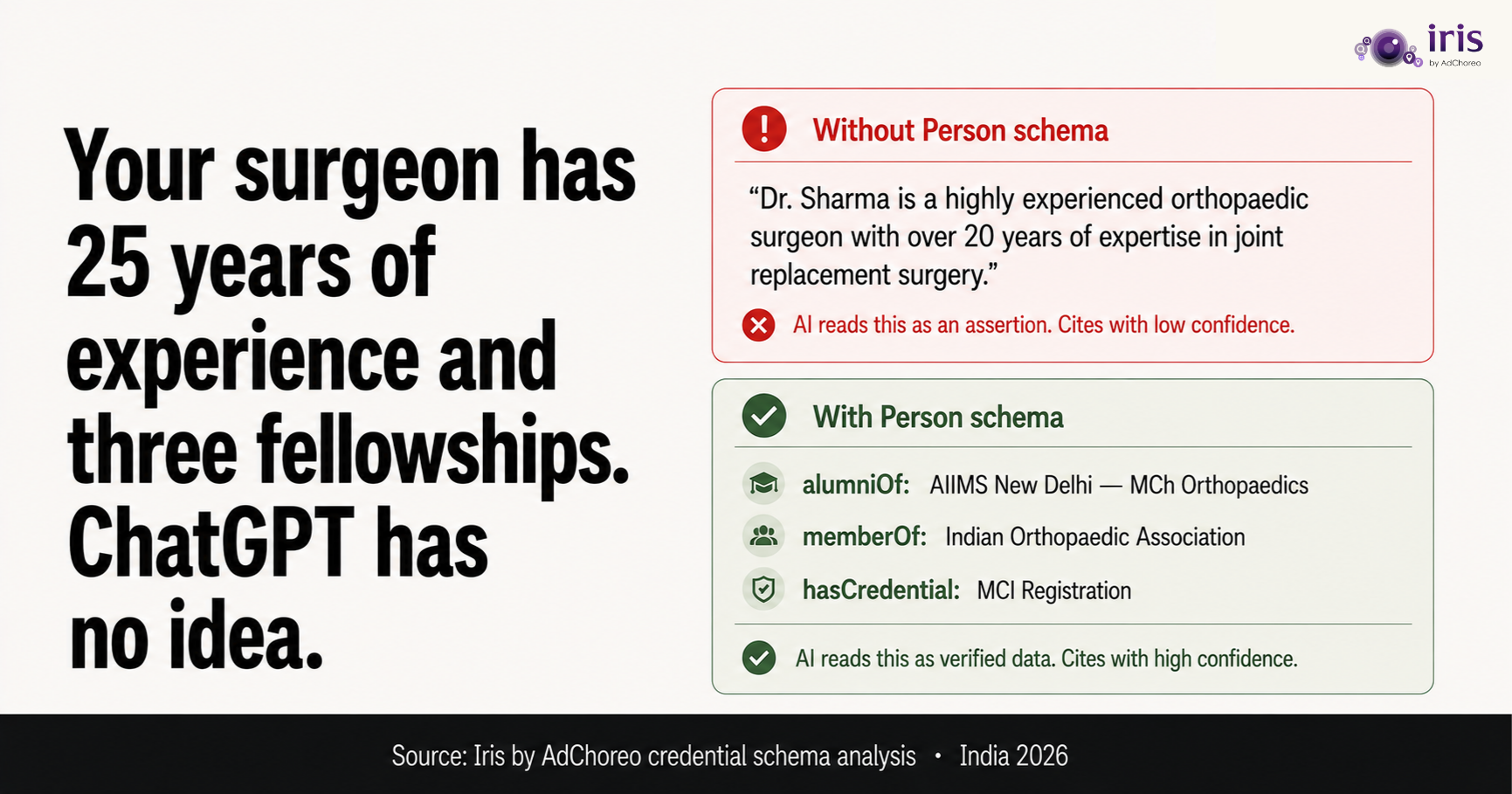
When a patient in Pune who needs a complex knee replacement asks ChatGPT "who is the best orthopaedic surgeon in Pune with fellowship training in joint replacement," the AI system needs to find physician credential data that is structured, machine-readable, and verifiable. It cannot reliably extract credentials from an unstructured biography paragraph that says "Dr. Sharma is a highly experienced orthopaedic surgeon with over 20 years of expertise in joint replacement surgery."
The sentence is true. The credentials are real. The fellowship is earned. ChatGPT simply cannot extract "fellowship in joint replacement" as a structured, verifiable credential from that marketing prose with any confidence. It treats it as an assertion rather than a verified attribute. The doctor whose website has Person schema with explicit alumniOf, memberOf, and hasCredential fields — even if their clinical experience is equivalent — is cited with more confidence and frequency for credential-specific queries.
Person schema is the on-domain equivalent of what Practo's doctor profile provides to AI systems: a structured, formatted credential statement. The difference is that Person schema on your own website builds authority for your clinic's domain. Practo's structured data builds authority for Practo.
Person schema is a JSON-LD block added to a doctor's profile page on the clinic website. A complete implementation for a plastic surgeon might look like this:
name: Dr. Priya Mehta
jobTitle: Plastic and Reconstructive Surgeon
medicalSpecialty: Plastic Surgery
alumniOf: [{"@type": "EducationalOrganization", "name": "AIIMS New Delhi", "description": "MBBS"}, {"@type": "EducationalOrganization", "name": "PGIMER Chandigarh", "description": "MS General Surgery"}, {"@type": "EducationalOrganization", "name": "Lokmanya Tilak Municipal Medical College Mumbai", "description": "MCh Plastic Surgery"}]
memberOf: [{"@type": "Organization", "name": "Association of Plastic Surgeons of India (APSI)"}, {"@type": "Organization", "name": "Indian Association of Aesthetic Plastic Surgeons (IAAPS)"}]
hasCredential: [{"@type": "EducationalOccupationalCredential", "credentialCategory": "Medical Registration", "recognizedBy": {"@type": "Organization", "name": "Medical Council of India"}}]
worksFor: The clinic entity (linked to the MedicalBusiness schema on the clinic's homepage)
This structured data is invisible to patients visiting the page. It lives in the page's HTML head section and is read only by AI crawlers and search engines. The result is that AI systems can extract specific, structured credential information rather than guessing from prose.
Indian medical credentials follow a specific hierarchy that needs to be represented accurately in Person schema for maximum AI citation value.
Primary medical degree: MBBS (alumniOf the medical college, with degree name)
Postgraduate specialty: MS (Surgery), MD (Medicine or relevant specialty), MDS (Dental), MDMS — with institution
Super-specialty: MCh (surgical specialties), DM (medical super-specialties), DNB (National Board) — with subspecialty
Fellowship training: Any fellowship from AIIMS, PGI, CMC Vellore, or international institutions (FRCS, FACS, ERBE) — these carry significant AI authority weight for high-stakes procedure queries
Professional registration: MCI/State Medical Council registration
Professional society memberships: APSI, IDA, AIOS, FOG, NeoFI, ISHRS, ISAR — relevant to specialty
Awards and honours: Optional, but meaningful for AI systems weight authority against competitive queries
Each of these credential types has a corresponding field in Person schema that AI systems are specifically designed to read. An AIIMS fellowship that appears only in a bio paragraph is treated with uncertainty. An AIIMS fellowship that appears in alumniOf schema is treated as a verified institutional affiliation.
Person schema adds value for all medical specialties but has the largest impact on AI citation for queries where credential verification matters most to patients.
Highest impact: Plastic surgery and cosmetic surgery (patients actively research surgeon qualifications), reproductive endocrinology and IVF (patients research fertility specialist credentials extensively), surgical oncology (cancer surgeon credentials are scrutinised carefully), spinal surgery and neurosurgery (high-stakes procedure, patients research fellowship training).
High impact: Ophthalmology and LASIK (patients research whether surgeon is a cornea subspecialist), orthopaedic surgery (joint replacement fellowship matters significantly to patients), paediatric medicine (parents research paediatric subspecialty credentials).
Moderate impact: Dental surgery (implant and cosmetic cases), dermatology (cosmetic subspecialty), psychiatry (DM Psychiatry vs MD Psychiatry credential distinction matters to some patients).
Lower but nonzero impact: General practice, family medicine, physiotherapy — credentials matter but AI systems weight other factors more heavily for these specialties.
The most important implementation detail for Person schema is connecting each doctor's schema entity to the clinic's MedicalBusiness schema using a worksFor or affiliation field. This tells AI systems that Dr. Priya Mehta (with her AIIMS credentials) works at [Clinic Name] (at this address, with these services) — and creates a verifiable entity relationship between the practitioner and the clinic.
Without this connection, the practitioner's Person schema exists as a floating entity that AI systems may not associate with the clinic's other schema blocks. With the connection, a query like "MCh plastic surgeon in Mumbai near Bandra" can match the practitioner's credential (MCh) and the clinic's location (Bandra, Mumbai) — producing a citation that neither the person schema nor the clinic schema alone could generate.
Free agentic readiness audit. Scored across all six AI visibility dimensions. No sales call required.
Run Your Free Audit → Over 1,000 independent clinics audited. Average score: 47 out of 100.