Schema MarkupTechnical GuideAI Visibility IndiaGEO
Schema Markup, Explained for Indian Clinic Owners Who Keep Hearing About It and Still Don't Know If They Have It.
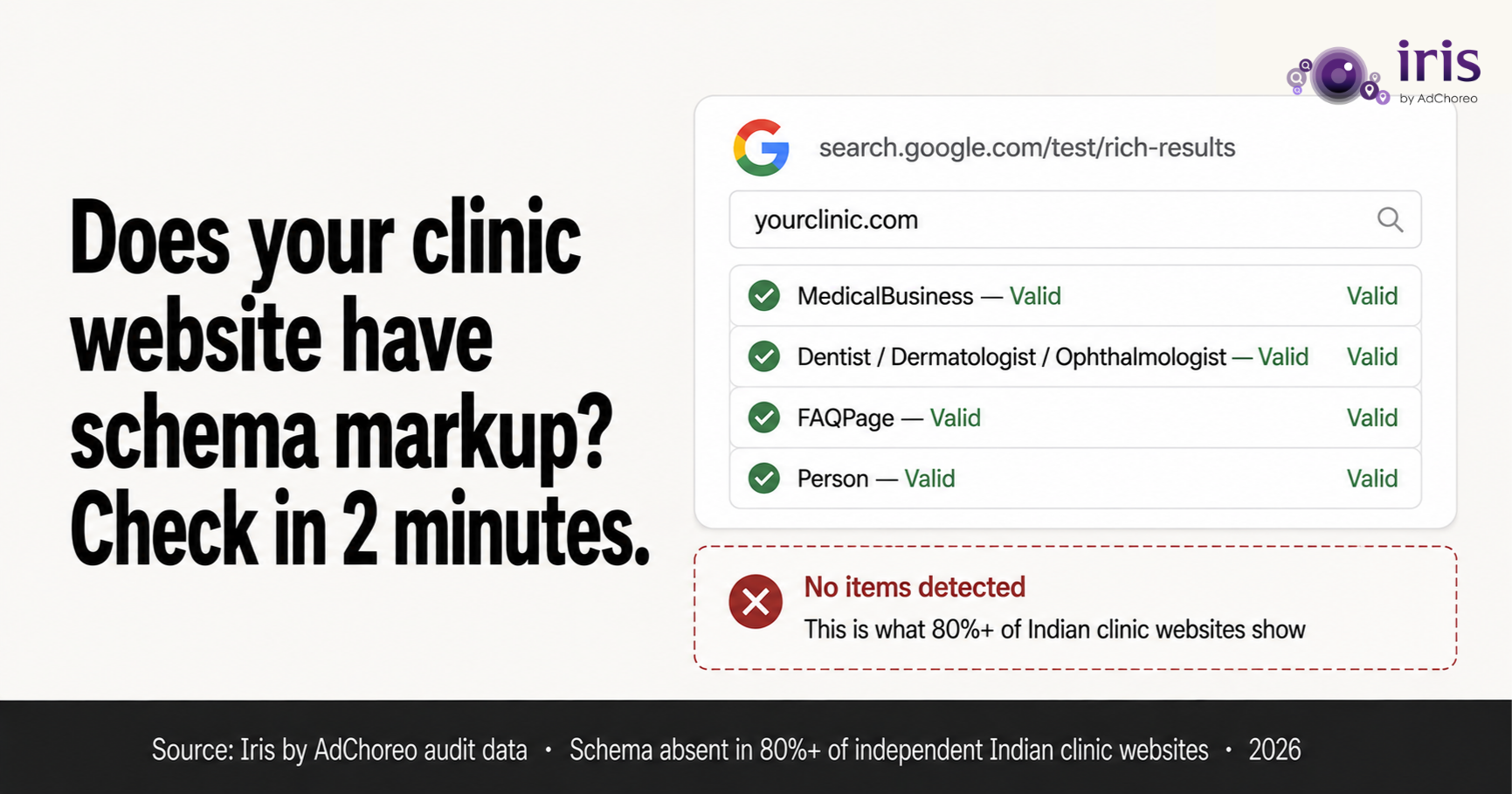
Schema markup is one of those terms that appears in every conversation about AI search visibility and is rarely explained clearly to the people who need to act on it. If you have been nodding along when your developer or marketing agency mentions schema without being sure what it is or whether your website has any, this article is for you.
Schema markup is structured data — code added to your website in a standardised format — that formally describes the entities on your page to AI systems and search engines. It is the difference between an AI system guessing that your website belongs to a medical clinic and an AI system knowing, with precision, that your website belongs to a Dermatologist named [Clinic Name] at [Address] in [City], offering MedicalProcedures including acne treatment, laser resurfacing, and pigmentation management, with practitioners whose credentials are verifiable.
The guessing version produces inconsistent citations, incorrect specialty classifications, and frequent omissions. The knowing version produces reliable citations, correct specialty recommendations, and accurate entity representation. Schema markup is what takes AI search from guessing to knowing.
Before anything else, find out whether your website currently has any schema markup — and if so, what kind. This takes two minutes and requires no technical knowledge.
Step 1: Open a browser and go to search.google.com/test/rich-results
Step 2: Type your clinic's website URL into the box and press the Test URL button.
Step 3: Wait 15-30 seconds while Google loads and analyses your page.
Step 4: Read the results.
If you see schema types listed — MedicalBusiness, Dentist, Dermatologist, Physician, LocalBusiness, FAQPage — your website has some schema markup. If you see only generic types like WebSite or WebPage, your website has basic schema but no medical-specific markup. If you see "No items detected," your website has no structured data at all.
Most Indian clinic websites that run this test land in the second or third category. The goal is the first — with the right medical-specific schema types active and valid.
The foundation. This formally declares your website as a medical practice entity. Schema.org has specific subtypes for different clinic types: Dentist, Dermatologist, Optician, Physician, MedicalClinic. Using the correct subtype — Dentist rather than generic LocalBusiness for a dental practice, Dermatologist rather than generic MedicalBusiness for a skin clinic — significantly improves how accurately AI systems classify and recommend your practice for specialty-specific queries.
What it enables: AI systems can correctly identify your clinic's specialty and include it in responses to specialty-specific queries. "Best dermatologist in Koramangala" will match a page with Dermatologist schema before it matches a page with generic MedicalBusiness schema.
One entry per treatment or procedure your clinic offers. Each entry includes the procedureName, procedureType (surgical or noninvasive), bodyLocation, and indication (the medical conditions it addresses). A skin clinic needs MedicalProcedure entries for acne treatment, laser hair removal, chemical peels, PRP therapy, and each other offered treatment.
What it enables: Procedure-level AI citations. When a patient asks ChatGPT "which skin clinic in [city] does PRP hair treatment," the clinics with MedicalProcedure schema entries for PRP appear as candidates. Clinics without it do not.
Applied to any page with question-and-answer content. The schema presents each Q&A pair in a machine-readable format that AI systems can directly extract. FAQPage schema is the most reliably cited schema type in Google AI Overviews for healthcare queries.
What it enables: Your patient FAQ answers become directly citable in AI responses. When a patient asks Google AI Mode "how long does LASIK recovery take," the clinic whose LASIK FAQ page has FAQPage schema with a direct answer in the first sentence gets cited. Clinics without this schema do not.
Applied to each doctor or practitioner's profile page. Includes alumniOf (medical college and fellowship), memberOf (professional associations like APSI, IDA, AIOS), hasCredential (MBBS, MS, MCh, DNB, board certifications), and hasOccupation (medical specialty). This formally declares the practitioner's credentials in machine-readable format.
What it enables: Credential-based AI citations. When a patient asks "which dermatologist in Bengaluru has DNB certification and specialises in hair loss," the AI can match credentials from Person schema — not from unstructured biography text.
Applied to specific HTML sections using CSS class references. Tells voice assistants which content to read aloud when a patient uses voice search to find a clinic. Without Speakable schema, Siri and Google Assistant default to reading only the clinic's name and address.
What it enables: Complete voice search recommendations. "PhysioPlus specialises in sports injury rehabilitation with same-day appointments available, located in Koramangala" rather than just "PhysioPlus, 27 MG Road."
Applied to the navigation path of each page. Tells AI systems how your website is structured and how pages relate to each other. Helps AI systems navigate from your homepage to your specific procedure pages efficiently.
What it enables: More complete website indexing by AI crawlers and better context about page hierarchy.
Schema markup is added to a website's HTML in a format called JSON-LD — a structured data format enclosed in a script tag. It lives in the head section of each page and is invisible to human visitors. A developer can add schema to most clinic websites in one to two days. On WordPress, plugins like RankMath or Yoast SEO can generate some schema types, though medical-specific schema typically requires manual JSON-LD implementation for full accuracy.
The schema should be structured as an @graph — a connected set of schema entities that reference each other — rather than separate schema blocks on separate pages. An @graph implementation formally connects the clinic entity, its practitioners, its services, and its location into a single coherent machine-readable entity profile, which is what gives AI systems high confidence in citing the clinic accurately and specifically.
Free agentic readiness audit. Scored across all six AI visibility dimensions. No sales call required.
Run Your Free Audit → Over 1,000 independent clinics audited. Average score: 47 out of 100.