Plastic SurgeryCosmetic SurgeryAI Search IndiaDigital Strategy
Plastic Surgery Clinics in India Built for Instagram. Instagram Is Not What AI Reads.
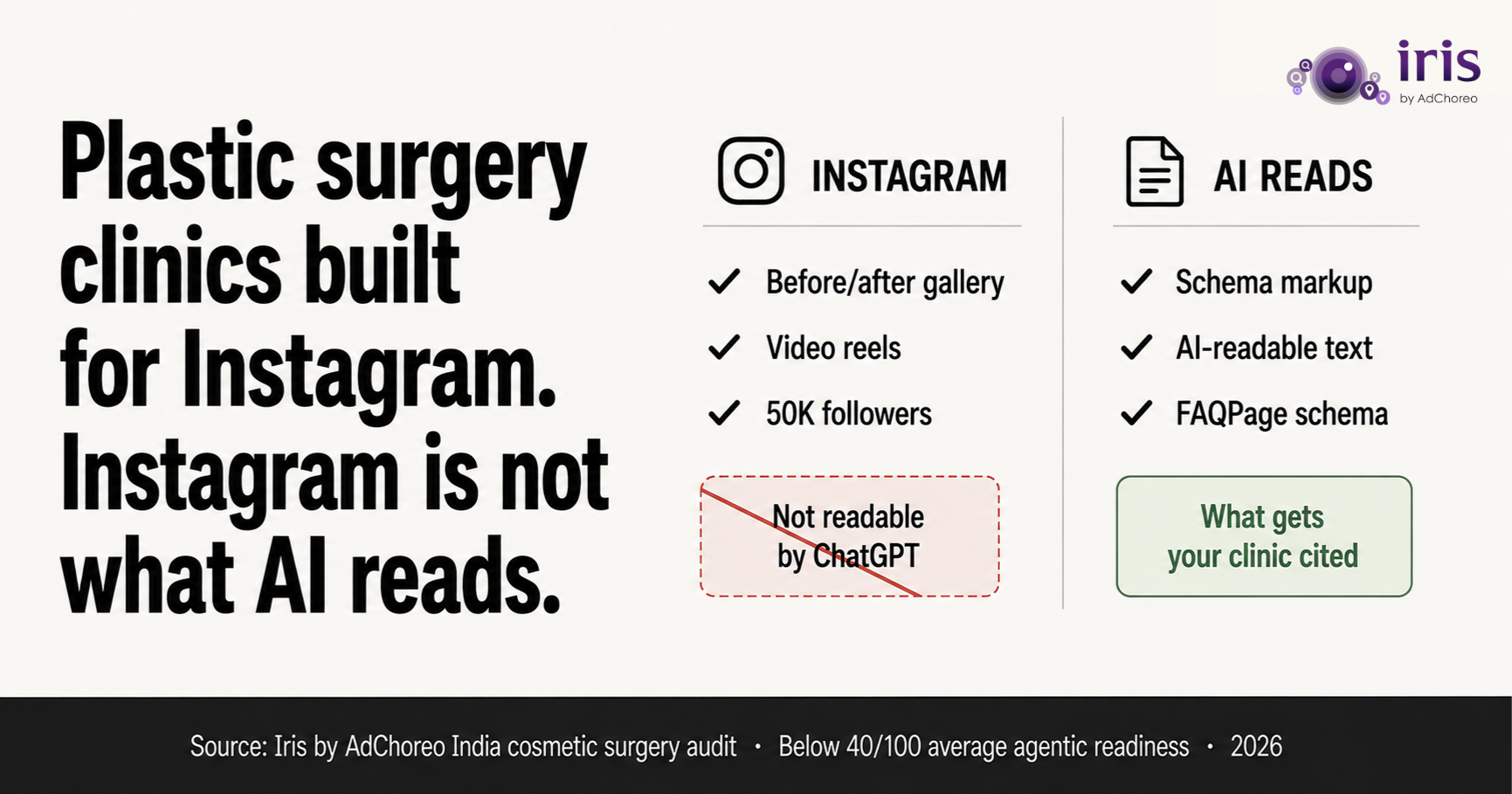
No healthcare specialty in India has invested more in visual digital presence than cosmetic and plastic surgery. The Instagram accounts are curated and high-quality. The websites have full-screen before/after galleries, video testimonials, and animated procedure explainers. The photography is professional. The design is intentional.
And when a patient in Mumbai opens ChatGPT and asks "which plastic surgeon in Juhu specialises in rhinoplasty and has good patient outcomes," most of that investment is irrelevant — because ChatGPT cannot read Instagram, cannot process before/after image galleries, and cannot extract clinical information from animated video content. What ChatGPT reads is structured text, schema markup, and crawlable HTML. Most cosmetic surgery clinic websites in India have very little of any of these.
Instagram-first design optimises for visual engagement. Images are large and high-resolution. Text is minimal. The homepage leads with a gallery or video reel rather than with text describing the surgeon's specialisation or the clinic's clinical capabilities. Navigation is visual. Service pages show before/after grids rather than procedure descriptions.
This design philosophy is correct for Instagram and for patients who discover the clinic through social media. It is structurally incompatible with AI search, for three reasons.
First, AI crawlers cannot process image content to extract clinical meaning. A before/after gallery for rhinoplasty — however high-quality — tells a ChatGPT crawler nothing about which specific rhinoplasty techniques the surgeon performs, whether open or closed approach, whether the surgeon does ethnic rhinoplasty for Indian nose anatomy, or what the recovery timeline looks like. The text content that would answer those questions is either absent or buried below visual content.
Second, minimal text means no direct extractable answer sentences for AI citation. A homepage that opens with a full-screen before/after slider and the tagline "Transform. Restore. Renew." gives the AI no direct, standalone sentence it can cite in response to "which plastic surgeon in [city] specialises in rhinoplasty." The AI needs text. It needs specificity. It needs inverted pyramid content that opens with the answer.
Third, visual-heavy websites are frequently built on platforms or with technical architectures (heavy JavaScript, image lazy loading, carousel components) that make them difficult for AI crawlers to parse even when text content exists. Cloudflare WAF configurations that protect visually-intensive sites often block AI crawlers as a side effect of blocking bot traffic generally.
Cosmetic surgery patients are not impulsive bookers. Rhinoplasty, abdominoplasty, breast augmentation, blepharoplasty, and liposuction patients research for weeks — sometimes months — before their first consultation. The research is emotionally charged and involves specific, complex questions that require clinically accurate answers.
These patients use AI chatbots in ways that go significantly beyond what Instagram can address. They ask ChatGPT: "What is the difference between open and closed rhinoplasty and which is better for a bulbous tip?" "Is it safe to combine rhinoplasty and chin augmentation in one surgery?" "What is the recovery timeline for a full facelift and when can I return to work?" "How long do breast implants last and what are the replacement risks?"
The cosmetic surgery clinic whose website has AI-readable pages for each of these questions — written in the inverted pyramid format, with FAQPage schema — becomes the cited authority for pre-consultation AI research. The clinic whose website is a beautiful image gallery with minimal text does not appear in these AI conversations at all.
Patients considering cosmetic surgery research surgeon credentials more intensively than patients in any other elective specialty. The questions are specific: Is the surgeon a plastic surgeon or a cosmetic surgeon? Are they MCh qualified? Are they a member of the Association of Plastic Surgeons of India (APSI)? Do they have fellowship training in specific subspecialties like craniofacial surgery or aesthetic surgery?
These credentials matter to patients, and patients ask AI chatbots about them. When a patient asks "who are the best rhinoplasty surgeons in Delhi with MCh qualification and APSI membership," AI systems can only answer with specificity if they have Person schema on the surgeon's profile page with explicit alumniOf, memberOf, and hasCredential fields. An unstructured biography paragraph that mentions these credentials in prose gives the AI much less confidence in citing the surgeon for this specific query.
Cosmetic surgery is a specialty where credential clarity is a genuine patient safety concern — patients are trying to distinguish qualified plastic surgeons from practitioners without formal plastic surgery training. AI-readable credential schema serves both the patient's information need and the qualified surgeon's visibility interest simultaneously.
Building AI visibility for a cosmetic surgery clinic does not require abandoning the visual design investment. The schema markup, llms.txt, robots.txt corrections, and content additions are a layer on top of the existing visual design — invisible to human visitors, read only by AI crawlers.
The content layer requires procedure description pages with text content that opens with direct, extractable answer sentences before the before/after gallery loads. A rhinoplasty page that opens with "Rhinoplasty at [Clinic Name] is performed using open or closed technique depending on the structural goals, by Dr. [Name] MCh (Plastic Surgery), APSI Fellow. The procedure addresses nasal tip definition, dorsal hump reduction, width correction, and breathing improvement under general anaesthesia, with an 8-10 day visible recovery period" is citeable. A page that opens with a fullscreen before/after slider is not.
The schema layer adds MedicalBusiness schema identifying the clinic as a plastic surgery practice, MedicalProcedure schema for each offered procedure, and Person schema for each surgeon with MBBS, MS, MCh qualification, fellowship, and professional society memberships. The llms.txt file guides AI crawlers to the text-rich procedure and FAQ pages rather than the image gallery pages, preserving crawl budget for indexable content.
Free agentic readiness audit. Scored across all six AI visibility dimensions. No sales call required.
Run Your Free Audit → Over 1,000 independent clinics audited. Average score: 47 out of 100.