Fertility ClinicsIVFAI Search India
The IVF Patient Spends Four Months Researching Before Their First Call. Is Your Fertility Clinic Visible During That Window?
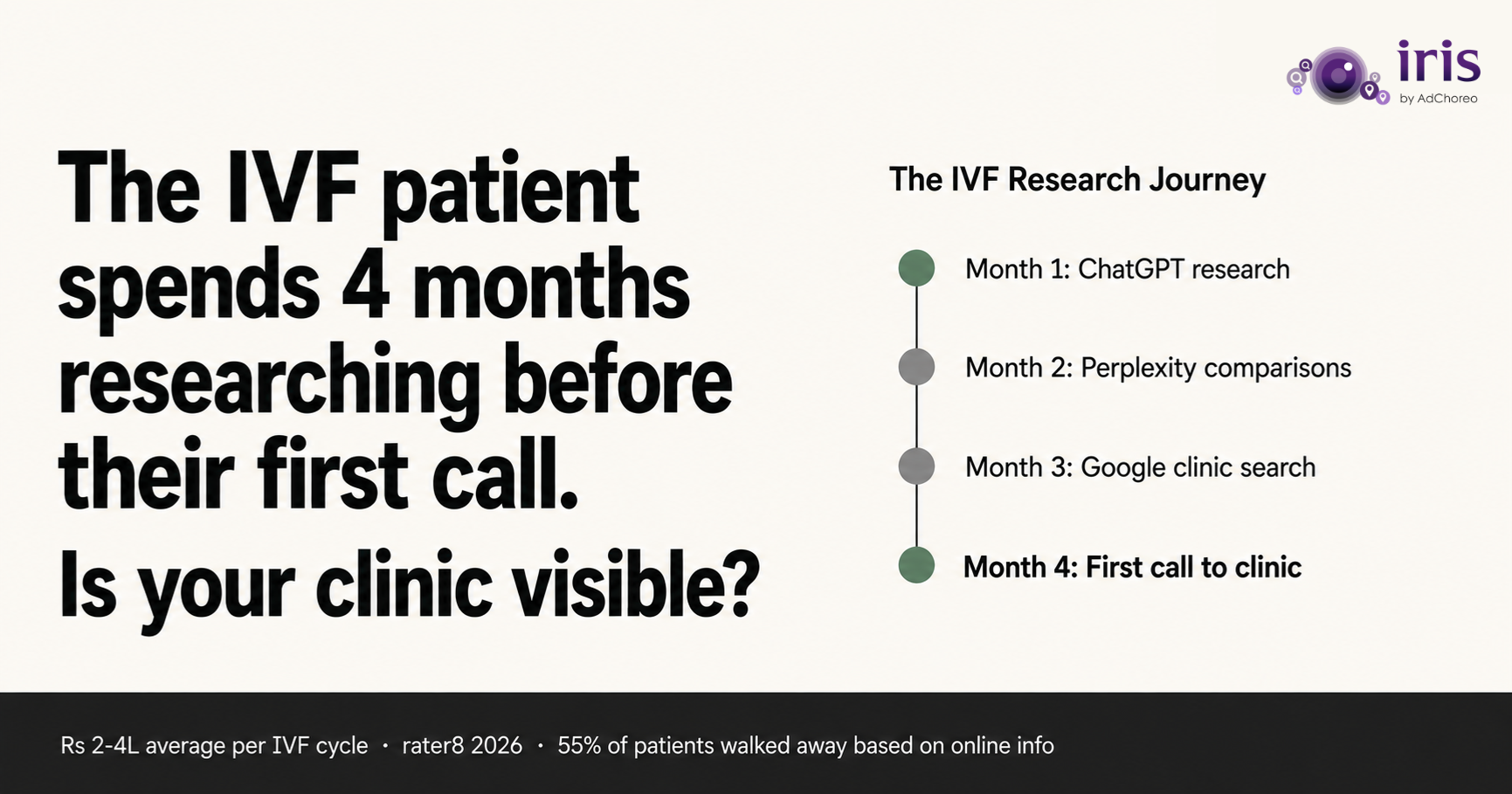
IVF is not an impulsive purchase. The average Indian family considering fertility treatment spends two to four months researching before they call a single clinic. They ask AI chatbots detailed, specific questions. They compare success rates by age group. They research embryologists and reproductive endocrinologists. They ask about the difference between IVF and ICSI, about the emotional and physical process, about what to expect at each stage. All of this happens before anyone at your clinic knows they exist.
The clinic that is visible during that research window — the clinic whose content shapes that family's understanding of the process, the terminology, and the quality benchmarks — enters the first consultation having already established authority. The clinic that is absent from that research window is competing, at the first consultation call, against the clinic that has been the family's trusted information source for four months.
In 2026, AI chatbots are where that four-month research begins. ChatGPT, Google AI Mode, and Perplexity handle the follow-up questions that traditional Google search requires multiple separate queries to address. And most IVF clinics in India are invisible on all of them.
The queries IVF patients direct at AI chatbots are specific, clinical, and high-intent. They are not asking generic questions. They are asking the questions they are afraid to ask their GP, questions they have been reading about on forums, questions that reveal exactly where they are in the emotional and informational arc of the decision.
The fertility clinic whose website contains directly answerable, AI-extractable responses to these specific questions gets cited. The clinic whose website has a generic "About IVF" page with marketing prose gets skipped. This is not a content quality judgment — it is a structural one. The same clinical information, written in the inverted pyramid format with FAQPage schema, gets cited repeatedly. The same information buried in paragraphs of marketing copy does not.
IVF patients ask about success rates more than any other single clinical topic. Success rates are the primary quality signal for a fertility clinic, and patients know it. But most IVF clinic websites in India present success rate information in the least AI-citable possible format.
A line that reads "We are proud of our exceptional success rates" tells an AI system nothing citeable. A page that presents "Our IVF success rate for patients aged 35-37 with fresh embryo transfer: 48%. For patients aged 38-40: 36%. For patients over 40 with donor eggs: 57%. Source: Our outcomes data, 2024-2025, ICMR-compliant reporting" gives the AI a specific, structured data point it can directly cite in response to the patient's question.
The success rate page should be structured as a FAQ: "What is your IVF success rate for my age group?" followed by the direct answer in the first sentence, then the methodology and context. FAQPage schema applied to this page makes it directly extractable by AI systems for every age-specific success rate query — one of the highest-volume informational query types in Indian fertility search.
IVF is a specialty where physician authority matters enormously to patients. The reproductive endocrinologist's training, the embryologist's experience, the lab director's certifications — these are genuine quality signals that patients research and weight heavily in their decision. The problem is that most IVF clinic websites present this information as unstructured text in a biography page.
An AI system reading "Dr. Priya Mehta completed her fellowship in Reproductive Endocrinology and Infertility at AIIMS New Delhi and has more than 15 years of experience in IVF" must interpret this with uncertainty. It cannot formally verify the fellowship, the institution, or the subspecialty. The same information structured as Person schema — with explicit alumniOf, memberOf, hasCredential, and hasOccupation fields — is read by AI as verified, machine-readable authority. When a patient asks "who is the best IVF specialist in Pune," the AI recommends the physician whose credentials are structured data, not the physician whose credentials are marketing copy.
Google Business Profile is the primary data source that Google AI Mode uses for local provider recommendations. The GBP primary category determines which patient queries your clinic is eligible to appear for in AI Mode's local search results.
Most IVF clinics in India have their GBP listed as "Medical Clinic" or "Doctor" — categories that AI Mode cannot map to "IVF centre near me," "fertility clinic Bengaluru," or "IVF hospital in Hyderabad." The correct primary category is Fertility Clinic, with secondary categories for Reproductive Health Clinic, IVF Clinic, and Gynecologist where applicable. Adding individual service entries for IVF, IUI, ICSI, egg freezing, donor egg IVF, and PGT makes each of those procedures separately matchable to patient queries.
This correction — changing a GBP primary category and adding service entries — takes 30 minutes and is among the highest single-action changes available to an IVF clinic in India.
Free agentic readiness audit. Scored across all six AI visibility dimensions. No sales call required.
Run Your Free Audit → Over 1,000 independent clinics audited. Average score: 47 out of 100.