55% of Patients Have Walked Away From a Clinic Based on What an AI Said About It. Is Yours at Risk?
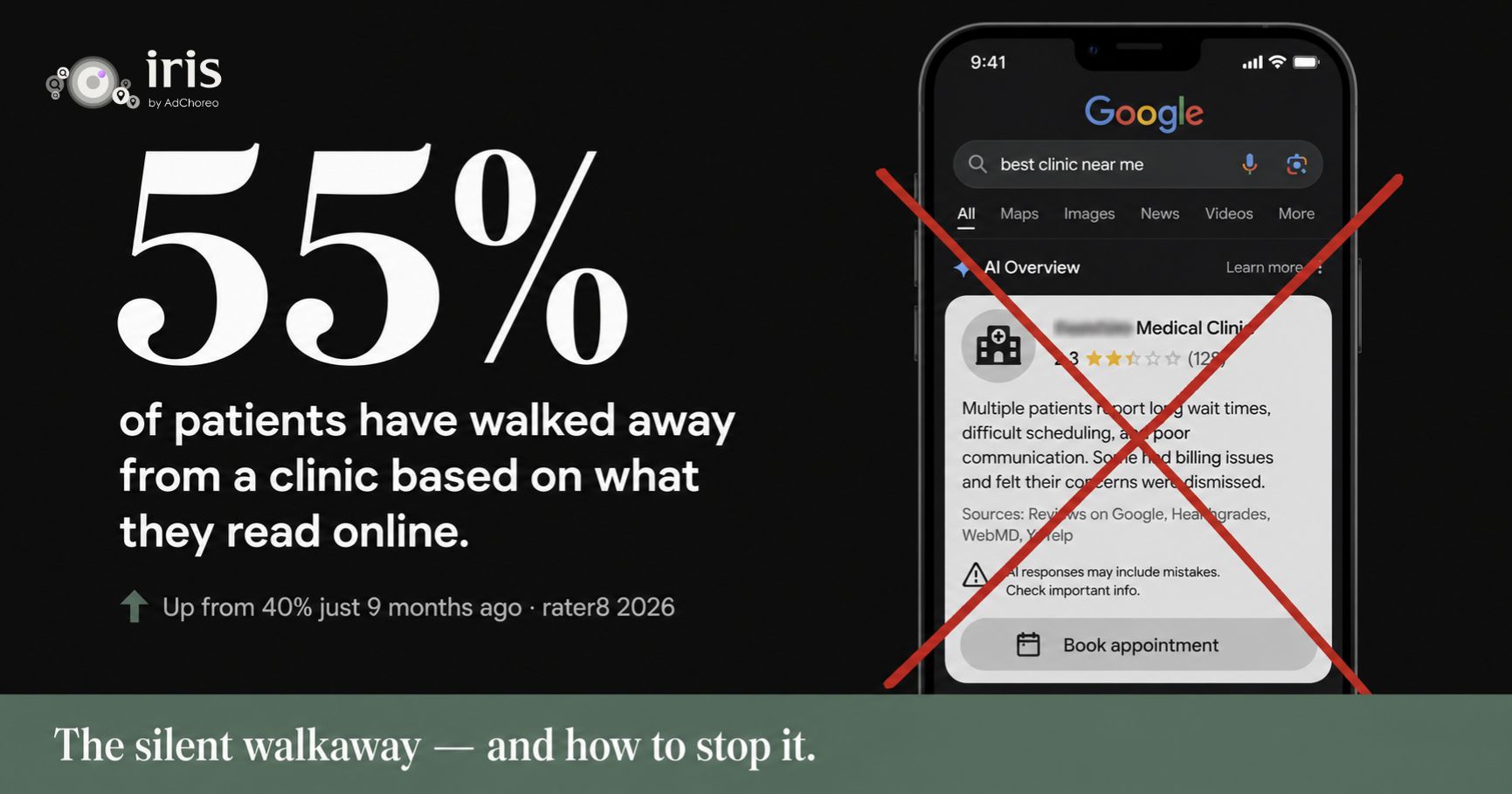
The most expensive patient a clinic loses is not the one who leaves after a bad experience. It's the one who never arrives — because what they found during their research phase was enough to send them somewhere else. rater8's 2026 Patient Choice Report (US data — the same behavioural shift is visible across Indian metros) puts a number on this: 55% of patients have walked away from at least one healthcare provider based on what they read online — up 15 percentage points from 2025, and up from 40% just nine months earlier. "What they read online" now includes AI-generated summaries. And when AI says the wrong thing about your clinic, you never find out.
Key Takeaways
- 55% of patients have walked away from a provider based on online information — the biggest year-on-year jump rater8 has recorded.
- 75% won't book below 4.0 stars. 44% won't book below 4.5 stars. AI systems cross-reference this rating data when constructing provider summaries.
- The walkaway is silent. Patients don't call to explain. There's no review, no lead, no visible signal. You experience it as a slow month with no obvious cause.
- Three types of AI walkaway — inaccurate citation, absent citation, and negative signal — each with a different cause and a different fix.
- 66% of patients say a provider's response to reviews influences their trust — up 24 percentage points in one year. Unanswered reviews are now an active AI walkaway risk.
The Three Types of AI-Driven Patient Walkaway
Type 1 — Inaccurate Citation: The AI Gets Something Wrong About You
AI systems construct their picture of a clinic from multiple sources: your website, GBP, Healthgrades, Justdial, Zocdoc, and any directory that has ever mentioned your clinic's name and address. When those sources disagree — because you moved, rebranded, changed your phone number, or added or discontinued services in the last 3–5 years — the AI synthesises an inaccurate response.
A patient who reads that you offer a service you discontinued, or finds an address that no longer exists, or sees hours that changed two years ago, typically doesn't call to verify. They assume the information is current and the clinic is disorganised. Common inaccuracy sources include:
- Old directory listings with previous address or phone number still live
- GBP categories that haven't been updated after a service change
- Hours inconsistencies between website, GBP, and third-party directories
- Service descriptions on aggregator sites that reflect a previous version of the practice
Type 2 — Absent Citation: A Competitor Shows Up and You Don't
The second type is not that AI says something bad about you. It's that AI says something good about a competitor — and says nothing about you. This is the most common walkaway type and the hardest to perceive from inside the practice, because there's no negative event to notice. Patients book elsewhere and the clinic experiences it as "lower lead volume" without a specific cause.
What makes a clinic absent from AI recommendations:
- AI crawlers (ChatGPT-User, PerplexityBot) blocked by robots.txt or Cloudflare WAF
- No llms.txt file — AI systems can't find the most important content
- No MedicalBusiness or specialty-specific schema — AI can't identify what type of clinic you are
- Content not structured for extraction — marketing prose provides nothing citable
Type 3 — Negative Signal Citation: AI Surfaces Something Damaging
The third type occurs when AI systems surface review content, ratings, or third-party signals that create a negative impression. According to rater8, the review complaints that most cause patients to walk away are:
- "Rude or unhelpful staff" — cited by 52% of patients as a dealbreaker
- "The doctor didn't listen" — 52%
- Substandard care — 45%
- Long wait times — 41%
- Billing issues — 40%
When AI Overviews surface review summaries containing these themes — which Google increasingly does for local provider queries — a clinic with unmanaged negative reviews gets a summary representation that leads directly to patient walkaway. The absence of a response to reviews now compounds this. 66% of patients say a provider's response to reviews influences their trust. A clinic with 200 five-star reviews and no responses reads differently than a clinic with 150 four-star reviews and thoughtful, individualised responses to every one.
"Patients hold healthcare providers to a higher standard than almost any other business, and that scrutiny now starts long before they ever walk through the door." — Evan Steele, Founder & CEO, rater8
A Three-Step Walkaway Risk Audit You Can Run Today
Step 1 — Check for inaccurate citation: Open a private browser window and search your clinic's name plus your city. Read the AI Overview carefully. Is the address current? Phone number correct? Services accurate? Hours right? Then search on Healthgrades, Justdial, and Zocdoc and compare. Every discrepancy is a live patient walkaway risk.
Step 2 — Check for absent citation: Open ChatGPT and run the query a patient would use: "best [specialty] in [your city]." Does your clinic appear? If a competitor does but you don't, you're experiencing Type 2 walkaway right now. Run the same query in Google AI Mode and compare.
Step 3 — Check for negative signal citation: Read your most recent 20 Google reviews as if you were a prospective patient. Note unanswered ones. Check your star rating is above 4.0 — the threshold below which 75% of patients won't book. Review your response rate and whether responses address the specific content of each review.
The full picture of your AI walkaway risk — across entity data consistency, AI visibility, schema markup, and review signal quality — is what the free Iris agentic readiness audit surfaces in 60 seconds. The silent walkaway is the most expensive loss in patient acquisition. It's also the most preventable once you can see it.