Patients Are Now Arriving With AI-Generated Diagnoses. The Clinic That Educated Them Before the Appointment Gets the Booking.
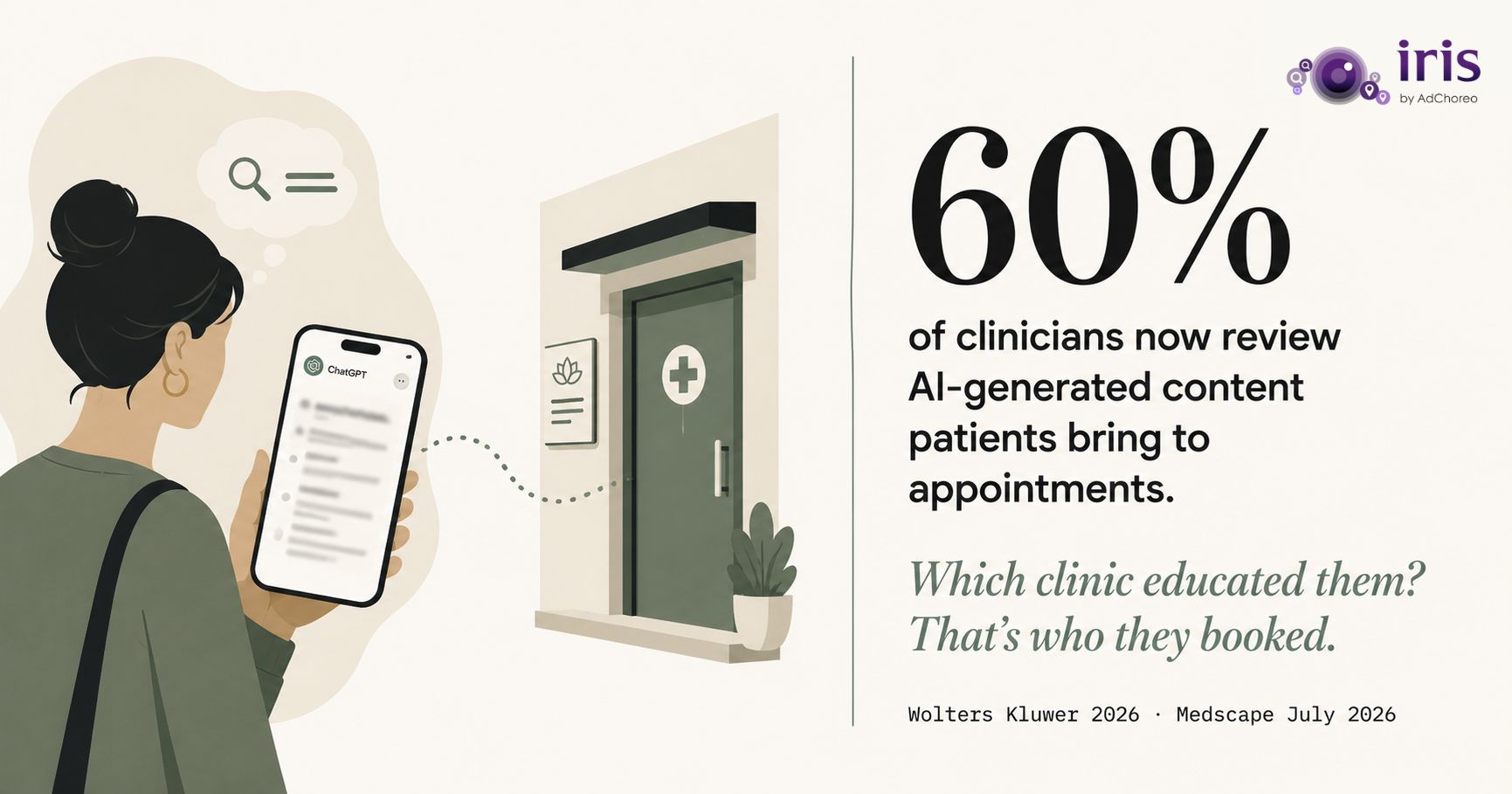
Medscape published a clinical piece on July 7, 2026 — "When Patients Arrive With AI Diagnoses" — describing a pattern now familiar to clinicians across virtually every specialty: patients entering consultations with a pre-formed understanding of their condition, generated by an AI tool they consulted before booking. Wolters Kluwer's 2026 data puts a number on it: 60% of clinicians now spend appointment time reviewing AI-generated health information patients bring with them. For the clinic whose content was the source that AI drew from, this is a competitive advantage that begins before the patient walks through the door.
Key Takeaways
- 60% of clinicians now spend appointment time reviewing AI-generated content patients bring in — Wolters Kluwer 2026.
- Symptom/health queries trigger AI Overviews 92% of the time — Stanford HAI 2026 AI Index. Your patients are being educated by AI before every appointment.
- The clinic whose content was cited enters the room first. It has already shaped the patient's vocabulary, understanding of options, and clinical credibility perception.
- Three content types drive pre-visit AI citation: condition explainers, FAQ hubs, and treatment comparison pages.
- Content written for keyword ranking rarely gets cited by AI. Content structured for extraction — direct answer sentence first, FAQPage schema, Speakable markup — does.
- The compounding advantage is real: a library of AI-citable content accumulates citation authority over time. A clinic that publishes nothing accumulates none.
The Consultation Has Already Started Before the Patient Arrives
Stanford's 2026 AI Index found that symptom and common health questions trigger Google AI Overviews 92% of the time. That means almost every health-related Google search produces an AI-generated summary before a single organic link is visible. For a patient who searched "what causes knee pain after 50," "what are the early signs of glaucoma," or "how does hair loss progress in women," their first substantive information was AI-generated — and it cited specific sources.
The clinic whose procedure and condition pages are formatted for AI extraction appears as a credible, citable source in these summaries. The clinic whose pages open with marketing prose appears in nothing. The patient who received their pre-visit education from your AI-cited content arrives predisposed to trust your clinical framing because:
- The terminology you use feels familiar to them
- The treatment approach you recommend aligns with what they already understand
- Your explanation confirms and extends what they read — rather than correcting it
- You entered the consultation as the established authority before the first word was spoken
"70% of patients and clinicians agree that AI is enabling better patient health literacy and engagement." — Wolters Kluwer, 2026 Future Ready Healthcare Report
Two Types of Appointment — And Why One Is Better
Medscape's clinical discussion surfaces two distinct clinician experiences with AI-arriving patients:
- The engaged patient: researched from quality sources, arrives with specific questions, has processed the basics, and is ready for a nuanced clinical conversation.
- The correcting appointment: arrived with AI-generated assertions that are partially incorrect, presented with confidence, requiring careful de-construction before the clinical work can begin.
The difference is largely determined by the quality of the AI sources the patient used. A patient whose pre-visit research came from your clinic's well-structured clinical content tends to arrive in the first category. A patient who drew from aggregator health sites or hallucinated AI content tends to arrive in the second. You don't control the AI. But you can control whether your content is what it draws from.
The Three Content Types That Drive Pre-Visit AI Citation
1. Condition and Symptom Explainers — Written in Inverted Pyramid Format
When a patient searches "what causes melasma?" or "what are the signs of a meniscus tear?", AI systems look for content that opens with a direct, extractable answer sentence. Compare:
- Citable: "Melasma is a common pigmentation condition caused by sun exposure, hormonal changes, and genetic predisposition, appearing as brown or grey-brown patches primarily on the face."
- Not citable: "At [Clinic Name], we understand that skin pigmentation concerns can affect your confidence and quality of life."
The opening sentence is the citation unit. Everything else is supporting material. Rewrite your procedure and condition page openings with this in mind.
2. FAQ Hubs With FAQPage Schema
Patient FAQ sections are among the most reliably cited content by AI systems answering pre-visit questions — because FAQPage schema provides clean, structured question-answer pairs that can be directly extracted. A well-structured FAQ hub with FAQPage schema applied correctly becomes a citation surface for dozens of patient queries, all representing patients in the pre-booking research phase. Prioritise questions like:
- "How long does recovery take after [procedure]?"
- "Will I need more than one session?"
- "What should I avoid before a [treatment]?"
- "What should I bring to my first consultation?"
3. Treatment Comparison Content
Patients frequently ask AI to compare options before selecting a provider: "What's the difference between HIFU and Ultherapy?", "Should I see a physio or orthopaedic surgeon first?", "Is laser or chemical peel better for acne scarring?" These have high pre-booking intent. A clinic with specific, fair, clinically accurate treatment comparison content captures these queries and becomes the authority who educated the patient before the booking decision — not after.
The Compounding Advantage of Building the Library
A clinic that publishes two well-structured pieces of clinical content per month — each formatted for AI extraction with direct answer sentences, FAQPage schema, and Speakable markup — builds a library over twelve months that covers most pre-visit queries relevant to its specialty. AI systems that have reliably cited a source accurately tend to cite it again for related queries. Citation authority compounds. A clinic that publishes nothing accumulates none.
If your clinical content is currently written for keyword ranking rather than AI extraction, the free Iris agentic readiness audit includes a content structure assessment as part of its six-dimension scoring. The gap between ranking content and citable content is usually structural — and it's the most directly actionable finding most clinics discover in their audit.