Hair TransplantFUEDHIAI Search India
Hair Transplant Patients in India Research for Six Weeks Before Their First Call. Most Clinics Are Invisible for All Six Weeks.
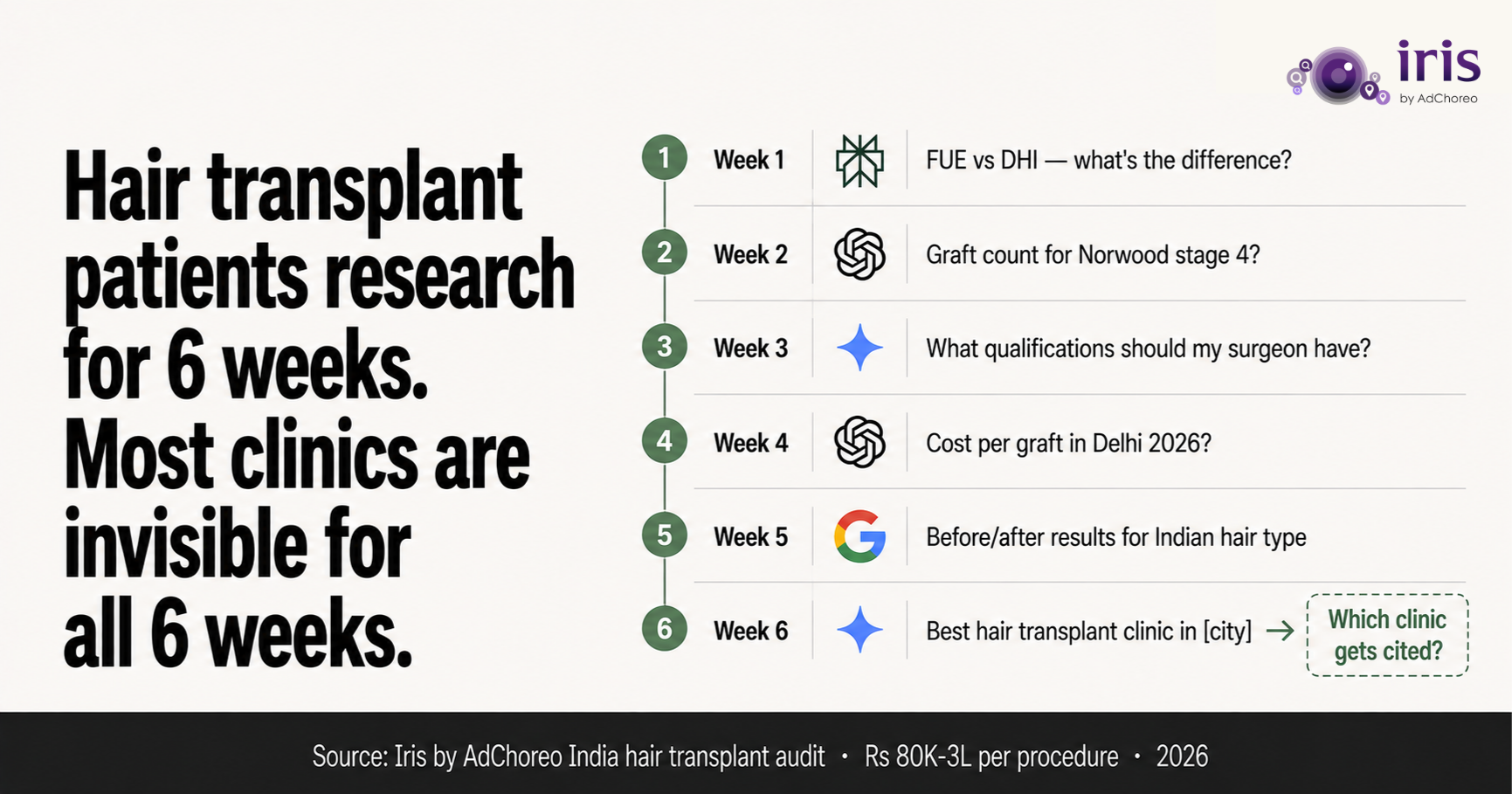
The hair transplant patient in India does not book a consultation impulsively. The decision typically takes 4-6 weeks of research — the longest pre-booking research window of any cosmetic procedure in Indian healthcare. The patient needs to understand the difference between FUE, DHI, and BHT techniques. They need to know how many grafts address their specific stage of hair loss. They need to evaluate surgeon qualifications and distinguish between clinics operated by qualified surgeons and those operated by technicians. They need to assess cost per graft, not total package price. They need to find before/after results that match their own hair type and density.
All of this research happens on AI chatbots, YouTube, and forums — in that order, for most patients under 40. The clinic that is cited in the AI chatbot conversations that happen across those six weeks enters the patient's consideration set before any competitor. The clinic that is absent from those conversations is competing, at the point of first contact, against the clinic that has been the patient's trusted information source for six weeks.
The research questions are technical, sequential, and specific. They reveal exactly what content a hair transplant clinic needs to build for AI citation.
Week 1 — Understanding the procedure: "What is the difference between FUE and DHI hair transplant?" "What is BHT (body hair transplant) and when is it recommended?" "How many grafts do I need for Norwood stage 4 hair loss?" "Is hair transplant permanent or does hair fall again?"
Week 2 — Evaluating techniques: "Which is better, FUE or DHI, for dense packing?" "What is the difference between motorised FUE and robotic ARTAS hair transplant?" "How long does a 3,000 graft FUE procedure take?" "What does the recovery timeline look like for DHI — day by day?"
Week 3 — Surgeon qualifications: "What qualifications should a hair transplant surgeon have in India?" "Is MBBS with MCh Plastic Surgery required for a hair transplant or can any doctor perform it?" "What is the difference between a certified ISHRS member and a non-certified hair transplant doctor?"
Week 4 — Cost research: "What is the cost per graft for FUE in Delhi in 2026?" "Why do some clinics charge Rs 20 per graft and others charge Rs 120?" "Are cheap hair transplant packages safe?"
Weeks 5-6 — Clinic selection: "Which hair transplant clinic in [city] is best for Indian hair type and high Norwood stages?" "What should I check before booking a hair transplant consultation?"
Each of these questions requires a specific, accurate, AI-citable answer. The clinic whose website has FAQ pages for each of these questions, with FAQPage schema applied, is cited across all six weeks of the patient's research journey.
Among all the content types a hair transplant clinic can build, the technique comparison page — FUE vs DHI, FUE vs BHT, traditional vs robotic — has the highest AI citation value. Comparison queries are extremely high intent and extremely specific. They indicate a patient who has done enough research to understand that options exist and is now trying to determine the right one for their situation.
A technique comparison page that opens with "FUE (Follicular Unit Extraction) and DHI (Direct Hair Implantation) are both graft extraction techniques. The key difference is implantation: FUE uses a recipient site creation step before implantation; DHI uses a Choi implanter pen to extract and implant in one step, enabling denser packing in smaller areas. DHI is generally preferred for hairline definition; FUE is typically used for larger coverage areas" — that opening paragraph is directly citable by AI systems for the "FUE vs DHI" query.
With FAQPage schema applied to this content, every sub-question in the comparison becomes individually extractable: "Which is better for high Norwood stages?" "Which has faster recovery?" "Which is more expensive?" Each extractable answer is a separate citation opportunity.
Hair transplant is a specialty where the surgeon qualification question is genuinely confusing for patients — and represents a significant safety concern. The procedure can be legally performed by any MBBS-qualified doctor in India, but the standard of care and outcome quality varies enormously between clinics operated by MCh Plastic Surgeons or DM Dermatologists with hair transplant subspecialty, and clinics operated by technicians under nominal medical supervision.
Patients understand this distinction exists and actively research it. When they ask AI chatbots "what qualifications should a hair transplant surgeon have in India," the AI's response is determined by whose content it can find and cite. A clinic whose surgeon's Person schema includes MCh Plastic Surgery, ISHRS membership, and DNB Dermatology credentials is more likely to be cited in that response than a clinic with no structured credential data. The credential-aware patient makes a qualification-informed decision. The clinic with structured credential data wins that patient's consideration.
Free agentic readiness audit. Scored across all six AI visibility dimensions. No sales call required.
Run Your Free Audit → Over 1,000 independent clinics audited. Average score: 47 out of 100.