Weight ManagementMetabolic HealthAI Search IndiaPCOS
Weight Management and Hormonal Health Are Among the Fastest-Growing AI Search Categories in Indian Healthcare. Most Clinics Are Invisible.
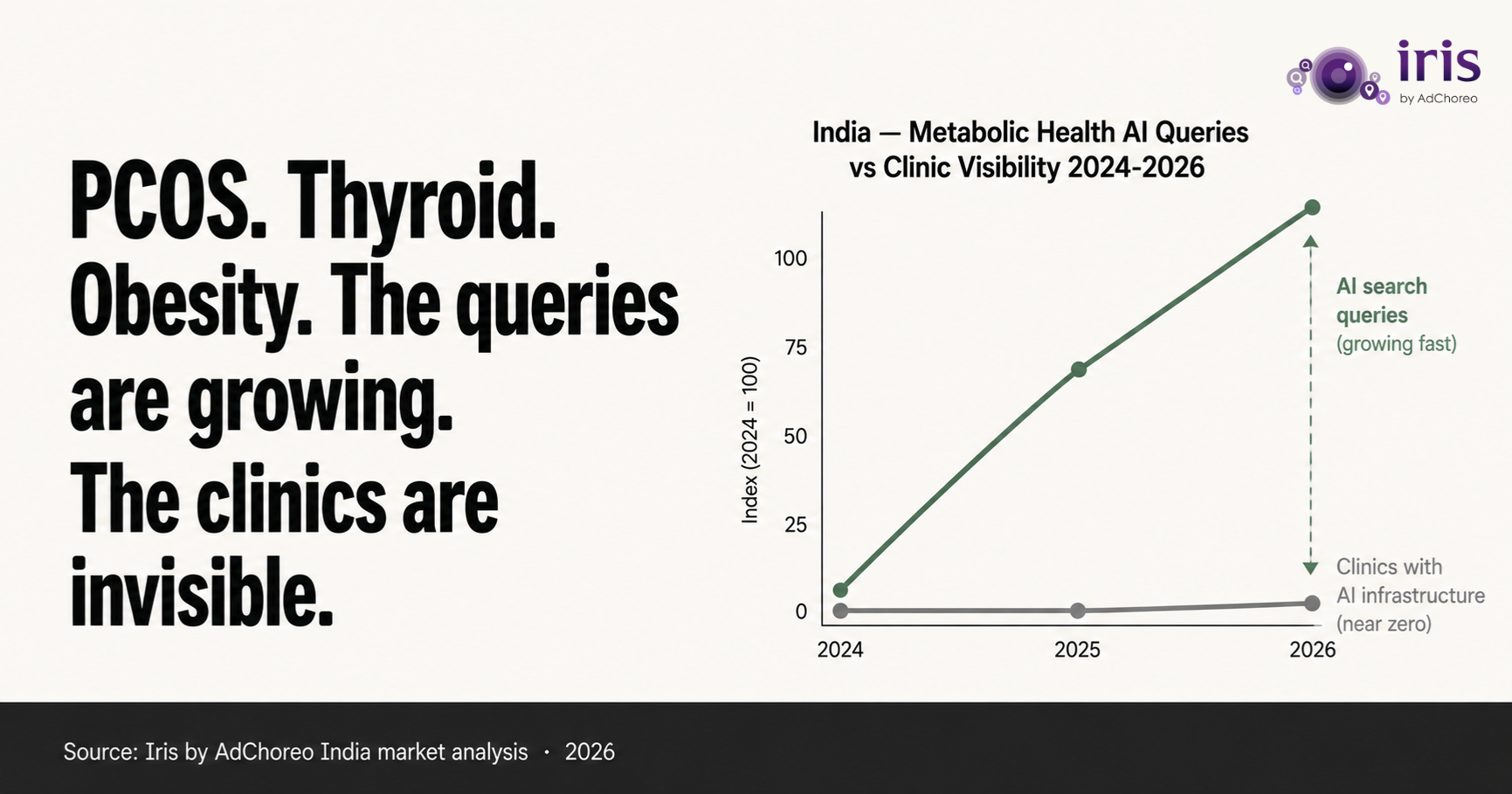
Urban India in 2026 is in the middle of a metabolic health crisis that is also, simultaneously, a health awareness surge. Patients are more informed about obesity, PCOS, thyroid disorders, and insulin resistance than any previous generation — in part because they are researching these conditions on AI chatbots before they see any clinician. A patient who has gained weight steadily over three years and suspects her thyroid may be involved does not call her GP first. She asks ChatGPT "what are the signs of hypothyroidism in Indian women" and "which specialist treats thyroid problems and weight gain — endocrinologist or nutritionist?"
This patient is in the pre-consultation research phase. The clinic that is cited in those AI responses is the clinic she looks up next. The clinic that is absent from those responses does not exist in her awareness until she eventually reaches a GP or sees a social media ad.
The AI search queries in the metabolic health space are medically nuanced and highly specific. Patients in this category have often spent months or years being told their symptoms are normal or stress-related. When they come to AI chatbots, they come with precise, frustrated questions that they have not been able to get satisfying answers to from traditional healthcare encounters.
These queries have extremely high booking intent. A patient who has reached the stage of asking this kind of specific, multi-part question to an AI chatbot is close to making an appointment. The clinic whose content is cited in the AI's response to these queries is the clinic that gets called.
Weight management and metabolic health clinics in India have some of the worst GBP category configurations of any healthcare specialty. The problem is that the specialty sits across multiple medical categories, and most clinics pick the wrong one.
A clinic that primarily treats obesity, PCOS, and metabolic syndrome lists itself as "Weight Loss Centre" — a fitness-adjacent category that AI systems cannot map to "endocrinologist near me for PCOS" or "diabetes management clinic Bengaluru." A clinic run by an endocrinologist lists as "Doctor" — a generic category that provides no specialty signal. A clinic offering nutritional counselling and medical weight management lists as "Nutritionist" — even though the value proposition is the medical, not the nutritional, component of the treatment.
The correct GBP configuration for a metabolic health clinic is: primary category of "Weight Control Service" or "Endocrinologist" (depending on the clinic's primary service offering), with secondary categories for "Nutritionist," "Diabetes Management," "PCOS Management," and the specific conditions the clinic treats. Service entries should include individual entries for each condition type — PCOS management, thyroid treatment, diabetes care, weight management, hormonal health — each with a description that maps to the patient queries AI systems receive.
Weight management and metabolic health clinic websites in India face a content challenge that is more acute than in other specialties: the temptation to make the website sound accessible and non-clinical has resulted in websites with essentially no AI-citable content.
A page that says "We believe that sustainable weight loss requires a holistic approach that addresses the root causes of weight gain through personalised nutrition, medical support, and lifestyle modification" is indistinguishable to an AI system from a fitness blog, a wellness centre, or a self-help website. It provides no specific, extractable information about what the clinic actually does medically.
A page that opens with "Our weight management programme includes a full hormonal and metabolic panel on day one, covering thyroid function, insulin resistance markers, sex hormone levels, and inflammatory markers. Based on results, a personalised medical protocol is designed — which may include GLP-1 receptor agonists, metformin, thyroid medication, or targeted nutritional intervention" gives an AI system a specific, medically grounded, directly citable description of what the clinic offers. The second version answers the patient's real question: what makes this clinic different from a diet programme or a gym.
Metabolic health and weight management have an outsized voice search opportunity because many of the most common patient queries are spontaneous and emotionally charged. A patient who just had a doctor dismiss her fatigue and weight gain as "stress" does not go home and carefully type a Google query. She speaks to her phone's assistant on the drive home. "Find an endocrinologist in Bengaluru who specialises in PCOS and thyroid" or "find a weight management clinic near me that does hormonal testing."
Voice search requires Speakable schema and LocalBusiness geo-coordinates on the clinic's website. Without them, voice assistants can only say the clinic's name and address — no description of the specialisation, no mention of the hormonal testing, no reason for the frustrated patient to choose your clinic over the next result. With them, the spoken recommendation can include the specific differentiation that speaks directly to what this patient has been searching for.
Free agentic readiness audit. Scored across all six AI visibility dimensions. No sales call required.
Run Your Free Audit → Over 1,000 independent clinics audited. Average score: 47 out of 100.