Voice Search IndiaRegional LanguagesHindiMulti-Language AI
Patients Are Asking Siri for Clinics in Hindi, Telugu, and Tamil. Is Your Clinic Showing Up in Any of Them?
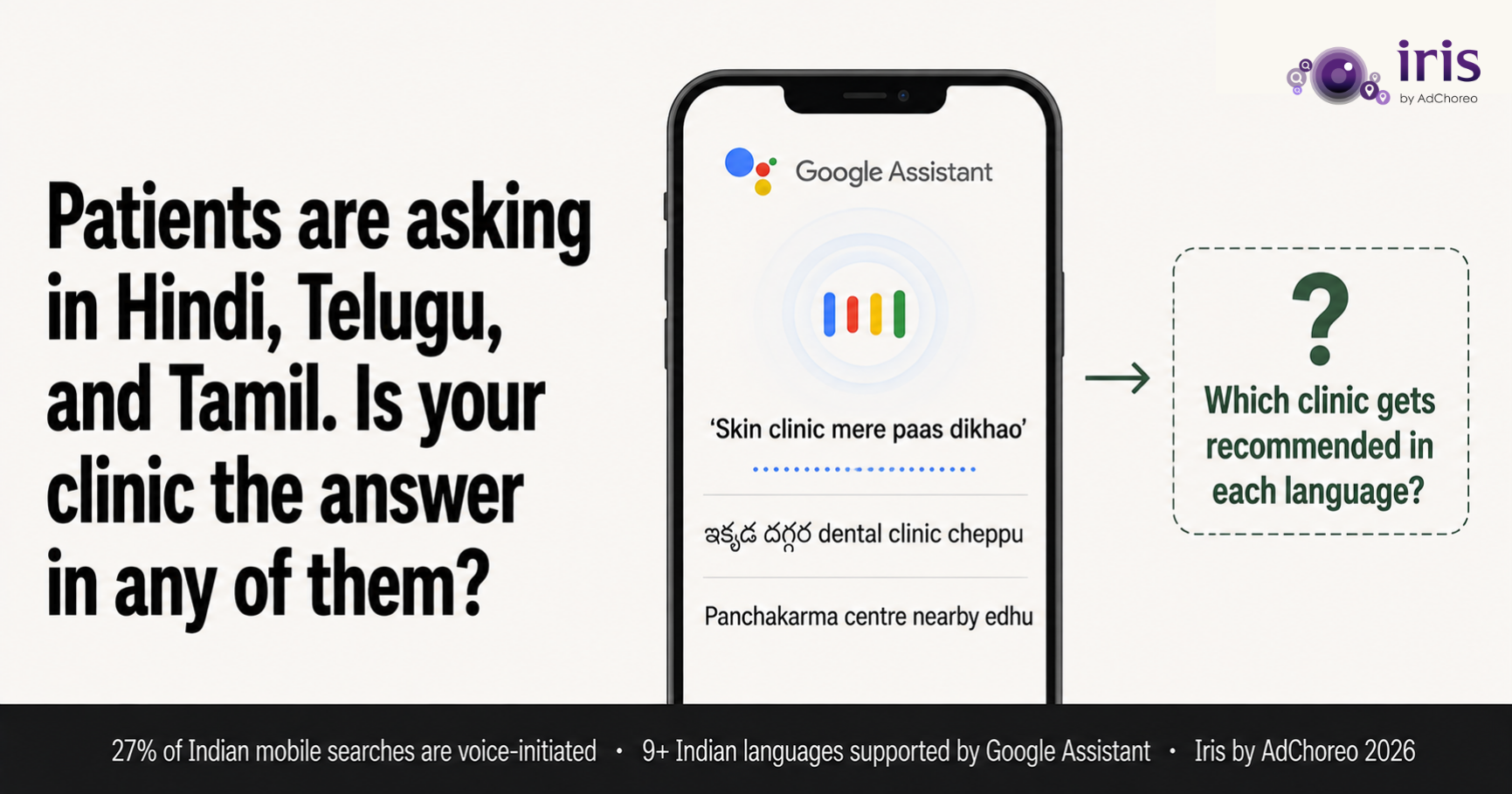
Open Google Assistant on an Android phone in Hyderabad and say, in Telugu: "ஸ்கின் க்ளினிக் near me." (Or in Hindi: "skin clinic mere pass dikhao.") Google Assistant, with Gemini's multilingual capabilities, understands this. It searches for skin clinics near the phone's location. The result it returns is determined by which clinics have Speakable schema, LocalBusiness geo-coordinates, and a correctly configured GBP. In almost every Indian city, the answer to which clinic appears in that Telugu or Hindi voice search is: none.
Regional language voice search for clinic discovery is the largest unaddressed patient acquisition opportunity in Indian healthcare in 2026. Not because patients aren't using it — they are, increasingly — but because no clinic in India has built the infrastructure to appear in it.
Urban Indian patients code-switch naturally and fluidly — mixing English and vernacular in speech. Voice search for clinic discovery reflects this. Common patterns observed across Indian metros and Tier 2 cities:
Voice assistants — Google Assistant with Gemini, Siri with updated LLM backend, Samsung Bixby — handle code-switching well in 2026. The challenge is not the voice assistant's comprehension. The challenge is that when the assistant resolves the query to a local clinic recommendation, the infrastructure required to produce a complete spoken response (not just a name and address) is absent from nearly every clinic in India.
Appearing in regional language voice search requires two layers of infrastructure that work together.
Layer 1 — GBP and proximity data (shared across all languages): The GBP primary category, service entries, geo-coordinates, and hours — all configured in the same way required for English voice search. This is the foundation. A clinic with an incomplete or incorrectly categorised GBP cannot appear in any voice search result, regardless of language.
Layer 2 — Language-specific content with Speakable schema: For a voice assistant to read a meaningful description of the clinic in a regional language, the clinic website needs content in that language tagged with Speakable schema. "PhysioPlus Sports Clinic offers sports injury rehabilitation and chronic pain treatment in Koramangala, Bengaluru, with same-week appointments available" — this Speakable-tagged content, if available in Kannada, produces a Kannada-language spoken recommendation when a Kannada-speaking patient uses voice search in Bengaluru.
Most Indian clinic websites are entirely in English. Vernacular content — Hindi, Tamil, Telugu — is absent. This means that even when a voice assistant resolves a vernacular query to a local clinic, the spoken response defaults to whatever English content can be found — typically just the clinic's name and address from GBP data.
Bengaluru clinics: Kannada first (local language, high volume in non-tech corridor localities), then Hindi (large migrant workforce population), then English (tech corridor patients).
Hyderabad clinics: Telugu first (dominant language, high voice search volume), then Hindi (significant northern migrant population), then English (HITEC City corridor).
Mumbai clinics: Hindi/Marathi (dominant, significant overlap in urban Mumbai), then Gujarati (large Gujarati-speaking community), then English.
Chennai clinics: Tamil first (dominant), then English (significant Anglophone patient base), then Telugu (large Telugu-speaking community in Chennai).
Delhi NCR clinics: Hindi first (dominant), then English, then Punjabi (Punjabi-speaking community in West Delhi and Gurugram).
Tier 2 city clinics: Local language exclusively — Jaipur (Rajasthani Hindi), Coimbatore (Tamil), Kochi (Malayalam), Nagpur (Marathi), Bhubaneswar (Odia). In Tier 2 cities, local language voice search is disproportionately high and English-only content is particularly limiting.
Building regional language voice search visibility does not require a full website rebuild. It requires adding specific content elements.
Homepage description in primary regional language: A 2-3 sentence description of the clinic's specialisation and location in the primary regional language for the city. Tagged with Speakable schema. This is the content voice assistants read aloud for regional language proximity queries.
Primary service descriptions in regional language: Brief, directly answerable descriptions of the clinic's main services in the regional language. The voice assistant reads these to answer "what does this clinic offer" follow-up queries.
FAQ content in regional language: 5-10 common patient questions and direct answers in the regional language. With FAQPage schema. This feeds regional language AI Overview citations and voice search answer extraction simultaneously.
The total content investment is small — perhaps 400-600 words per language — but the competitive effect is outsized because no other clinic in the market has done it.
Free agentic readiness audit. Scored across all six AI visibility dimensions. No sales call required.
Run Your Free Audit → Over 1,000 independent clinics audited. Average score: 47 out of 100.