PhysiotherapyVoice SearchBengaluruSports Medicine India
A Bengaluru Patient Said 'Hey Google, Find a Sports Physio Near Me' on the Drive Home From a Knee Injury. Here Is Exactly What Happened.
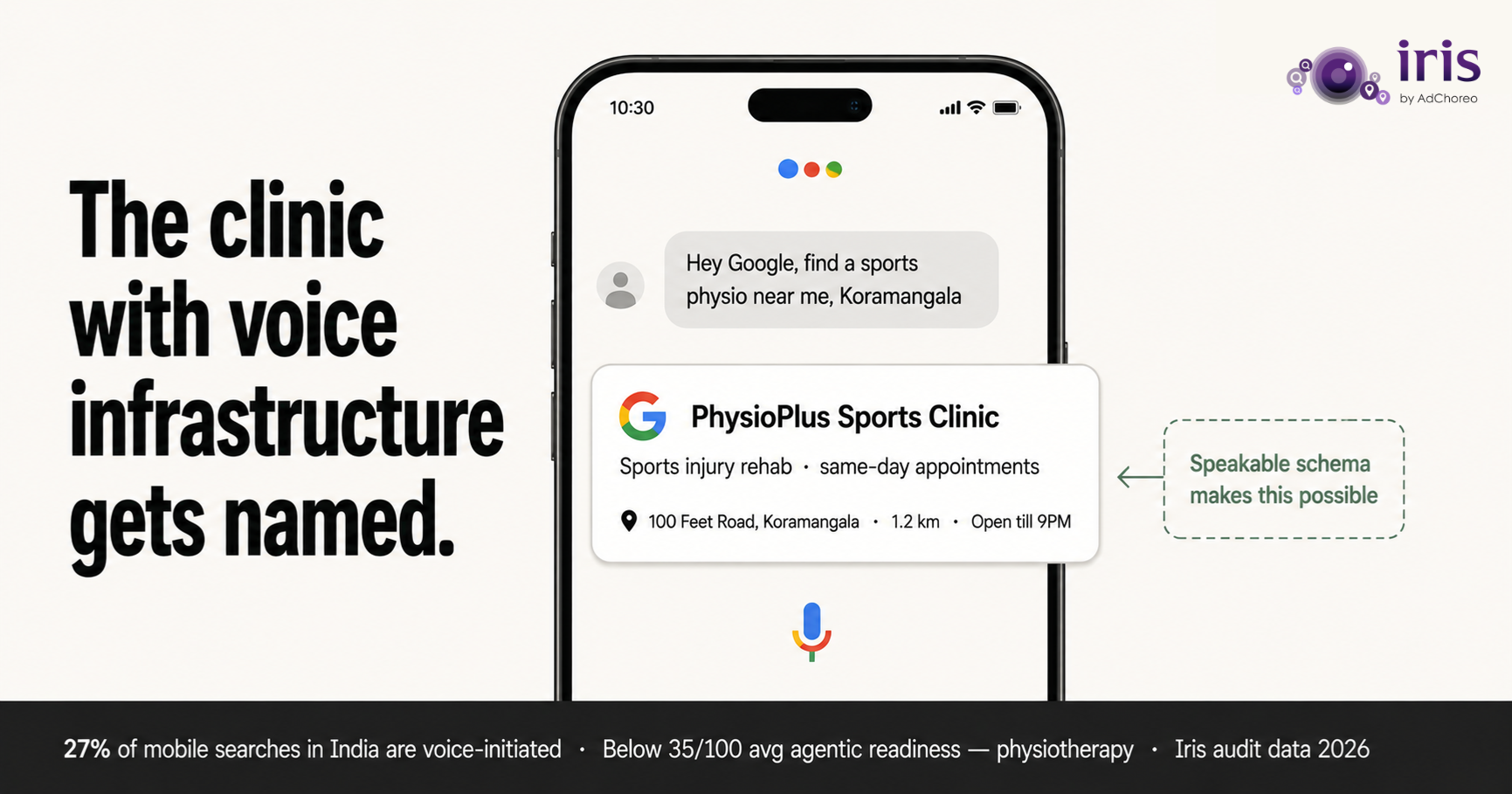
It is 7:30 PM on a Tuesday in Koramangala. A product manager at a tech firm has just twisted her knee badly on the basketball court in the Koramangala indoor sports facility. She is sitting in her car, in pain, holding her phone. She says: "Hey Google, find a sports physio near me open now."
What Google Assistant does next depends entirely on which physiotherapy clinics in Koramangala have Speakable schema, LocalBusiness geo-coordinates, and a GBP with same-day appointment information configured. For most clinics in Bengaluru, the answer is: none of these. Google Assistant reads her the name and address of the closest clinic with a relevant GBP category — no mention of sports injury specialisation, no indication of evening availability, no spoken description of what makes that clinic the right choice for her specific injury.
Compare this to what the response could be for a clinic that has built the right infrastructure: "PhysioPlus Sports Clinic specialises in acute sports injury rehabilitation with same-day appointments available for knee, ankle, and shoulder injuries. Located on 100 Feet Road, Koramangala, open until 9 PM on weekdays." That spoken recommendation contains exactly the information the patient needs to make a decision. It converts. The name-and-address response does not.
Bengaluru's specific combination of characteristics makes it the most attractive market in India for physiotherapy AI visibility investment. The city's tech workforce is young (median age 31-35 in the tech corridor), highly active (badminton, cricket, running, gym, cycling, and yoga are dominant weekend activities), and extremely AI-native in its information behaviour.
This same population has a high injury rate. Desk-bound work weeks followed by intensive weekend sports creates a specific injury profile — overuse injuries, acute ligament sprains, back and neck pain from poor posture, gym injuries. These injuries are urgent — they interfere with work and life — and they require physiotherapy input quickly. The combination of urgency and AI search native behaviour means that Bengaluru's sports and tech community is exactly the population most likely to use voice search to find a physio immediately after an injury.
In Koramangala, Indiranagar, HSR Layout, Whitefield, and the Marathahalli corridor — all high-density tech workforce localities — the combination of high patient volume and near-zero AI infrastructure among physiotherapy clinics creates the widest competitive window of any specialty and geography combination Iris has assessed.
Failure mode one: Wrong GBP category. Many physiotherapy clinics in Bengaluru are listed under "Doctor" or "Medical Clinic" — generic categories that Google Assistant cannot map to "sports physio near me" or "physiotherapy for knee injury." The correct primary category is "Physiotherapist," with secondary categories for Sports Medicine Physician, Physical Therapist, and Sports Injury Clinic where appropriate. This single correction changes which queries the clinic appears as a candidate for in voice search.
Failure mode two: No Speakable schema. Even when a physio clinic appears as a candidate in voice search, the lack of Speakable schema means the voice assistant has no guidance on what to read aloud. It defaults to the GBP address and basic information. The clinic's sports medicine specialisation, its same-day availability, its specific injury expertise — none of this gets spoken to the patient unless it is tagged with Speakable schema on the clinic's website and cross-referenced with the GBP.
Failure mode three: No LocalBusiness geo-coordinates. Voice search proximity verification requires LocalBusiness schema with explicit latitude and longitude coordinates on the clinic's website. Without geo-coordinates, voice assistants cannot confirm the clinic's proximity to the patient's current location with the confidence required to include it in a proximity-based recommendation.
The goal of voice search infrastructure is to produce a spoken recommendation that contains the information a patient needs to make an immediate booking decision. For a sports physiotherapy clinic targeting Bengaluru's tech workforce, that means:
Every element of this response comes from a specific infrastructure source. The specialisation comes from Speakable-tagged content on the clinic's homepage. The availability comes from GBP service hours and Q&A content. The proximity comes from LocalBusiness geo-coordinates matched to the patient's device location. Building these four sources is what converts a voice search from a name-and-address response to a spoken recommendation that drives an immediate call.
Beyond voice search, physiotherapy clinics in Bengaluru are missing a significant AI citation opportunity in condition-specific search — the queries patients make when they have a specific injury or condition and want to understand what physiotherapy can do for it before they book.
"Can physiotherapy fix a partial ACL tear without surgery?", "How many sessions does physiotherapy take for a frozen shoulder?", "What exercises does a physio give for disc herniation?" — these queries have high pre-booking intent and require condition-specific FAQ pages with FAQPage schema. A Bengaluru sports physio clinic with pages for ACL injuries, rotator cuff problems, disc herniation, runner's knee, and work-related back pain — each written with direct opening answer sentences and FAQPage schema — becomes the AI-cited authority for those conditions in its locality. The patient who gets that citation is much more likely to book than one who found the clinic through a generic GBP listing.
Free agentic readiness audit. Scored across all six AI visibility dimensions. No sales call required.
Run Your Free Audit → Over 1,000 independent clinics audited. Average score: 47 out of 100.