Tier 2 Cities IndiaAI Patient DiscoveryJaipurCoimbatoreKochi
In Tier 2 Indian Cities, Patients Are Using AI to Skip the GP and Find Specialists Directly. Most Clinics in These Cities Are Invisible.
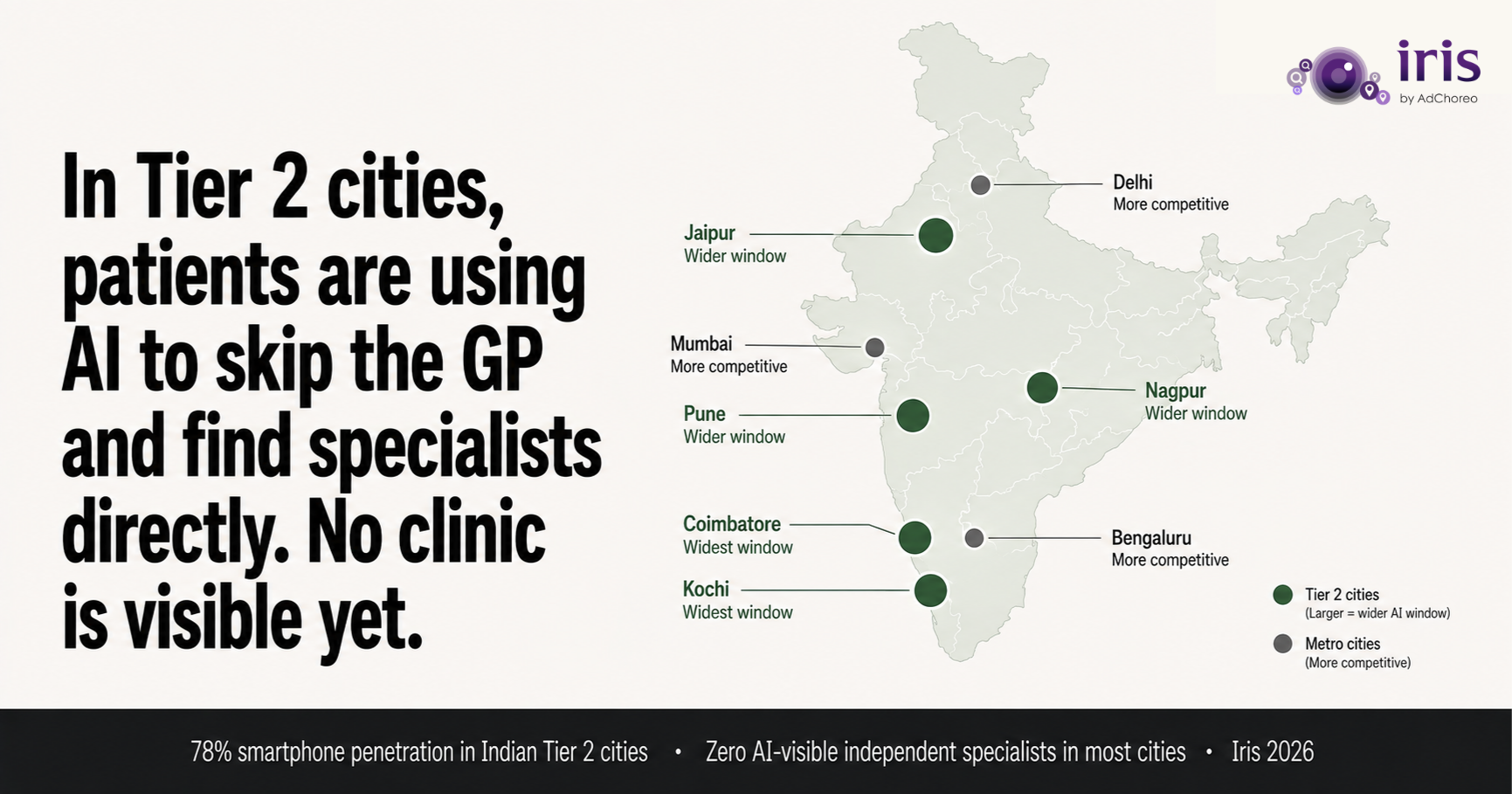
The conventional wisdom about healthcare digitisation in India runs something like this: metros lead, Tier 2 cities follow with a 3-5 year lag. But AI-mediated patient discovery is breaking that pattern. Smartphone penetration in Tier 2 cities reached 78% by 2025. ChatGPT and Google AI Mode have no friction barrier — any smartphone user with mobile data can access them. And the younger demographics in Jaipur, Coimbatore, Kochi, and Nagpur, who grew up with smartphones, are using AI chatbots for healthcare research at rates that are not meaningfully different from their counterparts in Bengaluru or Mumbai.
What is meaningfully different is the supply side. Specialist clinics in Tier 2 Indian cities have significantly less digital infrastructure than their metro counterparts. Many have no GBP at all. Most that do have GBPs have incomplete, uncategorised profiles. Virtually none have schema markup, llms.txt files, or AI-readable content. The result is a demand-supply gap that is larger in Tier 2 cities than in any Indian metro — and a first-mover AI visibility opportunity that is correspondingly more valuable.
In Indian metros, specialist access has historically been easier — more specialists, more GPs who know them, more established referral networks. In Tier 2 cities, the referral network is thinner. A patient in Kochi who needs an orthopaedic surgeon for a sports injury has historically either waited for a GP referral, relied on word-of-mouth, or made the trip to a metro hospital. AI chatbots are changing this. A patient can now ask ChatGPT "who is the best orthopaedic surgeon in Kochi for sports injuries" and receive a direct recommendation — bypassing the GP referral entirely.
The national rater8 2026 data showing that AI influence on provider choice (36%) overtook GP referrals (32%) applies with particular force in Tier 2 cities, where the GP referral infrastructure was never as strong as in metros. The demographic that has adopted AI healthcare search fastest — 25-40 year olds with smartphones — is also the demographic most likely to bypass the GP and contact a specialist directly when AI gives them the confidence to do so.
Jaipur: Rajasthan's largest city is experiencing rapid healthcare infrastructure growth. Specialties with high patient demand and low AI visibility: orthopaedics (sports injuries in the large student population, arthritis in the older population), gynaecology and IVF, dental implants, and skin clinics serving a growing middle class. The GBP landscape in Jaipur is notably underdeveloped — many specialist clinics have no GBP or have GBPs with no category selection.
Coimbatore: A manufacturing and education hub with a large, stable middle-class population and a strong tradition of seeking specialist healthcare locally rather than travelling to Chennai. Specialties with high demand and low AI visibility: cardiology and diabetes management (high burden of chronic disease), orthopaedics, dental implants, and ENT. Coimbatore patients who previously asked family for specialist recommendations are transitioning to AI search — and finding mostly silence from the city's specialist clinics.
Kochi: Kerala's highest smartphone penetration state, combined with the strongest health awareness culture in India, produces a patient population that is both highly medically literate and rapidly adopting AI for healthcare research. Specialties with high demand and low AI visibility: wellness and Ayurveda (national and international patient base), IVF and reproductive medicine, cancer treatment, and ophthalmology. The Kerala Ayurveda tradition is globally recognised but almost entirely absent from AI search results.
Nagpur: Central India's largest city, with a significant referral patient base from surrounding Maharashtra, Madhya Pradesh, and Chhattisgarh. Specialties with high demand: cancer treatment, orthopaedics, cardiac surgery, and general surgery. Nagpur has significant hospital chain presence but a large independent specialist ecosystem that is almost entirely AI-invisible.
Chandigarh: A high-income Tier 2 city with a patient population that researches extensively before making healthcare decisions. Dental implants, cosmetic surgery, IVF, and LASIK are high-volume categories with low AI visibility among independent clinics in the city.
The infrastructure requirements are identical to metros. The competitive landscape when doing so is radically different.
In a Tier 2 city, the first specialist in any category to build AI visibility is not displacing an AI-visible incumbent — there are no incumbents. They are claiming first-mover position in an uncontested field. In Kochi, no Ayurveda centre is AI-visible. In Jaipur, no orthopaedic surgeon is AI-visible. In Coimbatore, no IVF clinic is AI-visible. The first to build it in each of these cities faces zero competition for that position.
This is an unusually strong first-mover dynamic even by the standards of India's already wide-open AI visibility market. The compounding effect of early citation authority — where early citations build confidence for future citations — will be more durable in Tier 2 cities than in metros, because fewer competitors will catch up quickly.
For a specialist in a Tier 2 city, the decision to build AI visibility in 2026 is less a competitive response and more a category creation. The first physiotherapist in Nagpur with Speakable schema is not the "best AI-visible physio in Nagpur" — they are the only AI-visible physio in Nagpur. That position is worth building.
Free agentic readiness audit. Scored across all six AI visibility dimensions. No sales call required.
Run Your Free Audit → Over 1,000 independent clinics audited. Average score: 47 out of 100.