OrthopaedicsJoint ReplacementAI Search IndiaPre-Referral Research
An Orthopaedic Patient in Pune Was Shortlisted a Surgeon on Perplexity Before the GP Referral Was Written. Here Is the Pre-Referral AI Research Journey in Indian Healthcare.
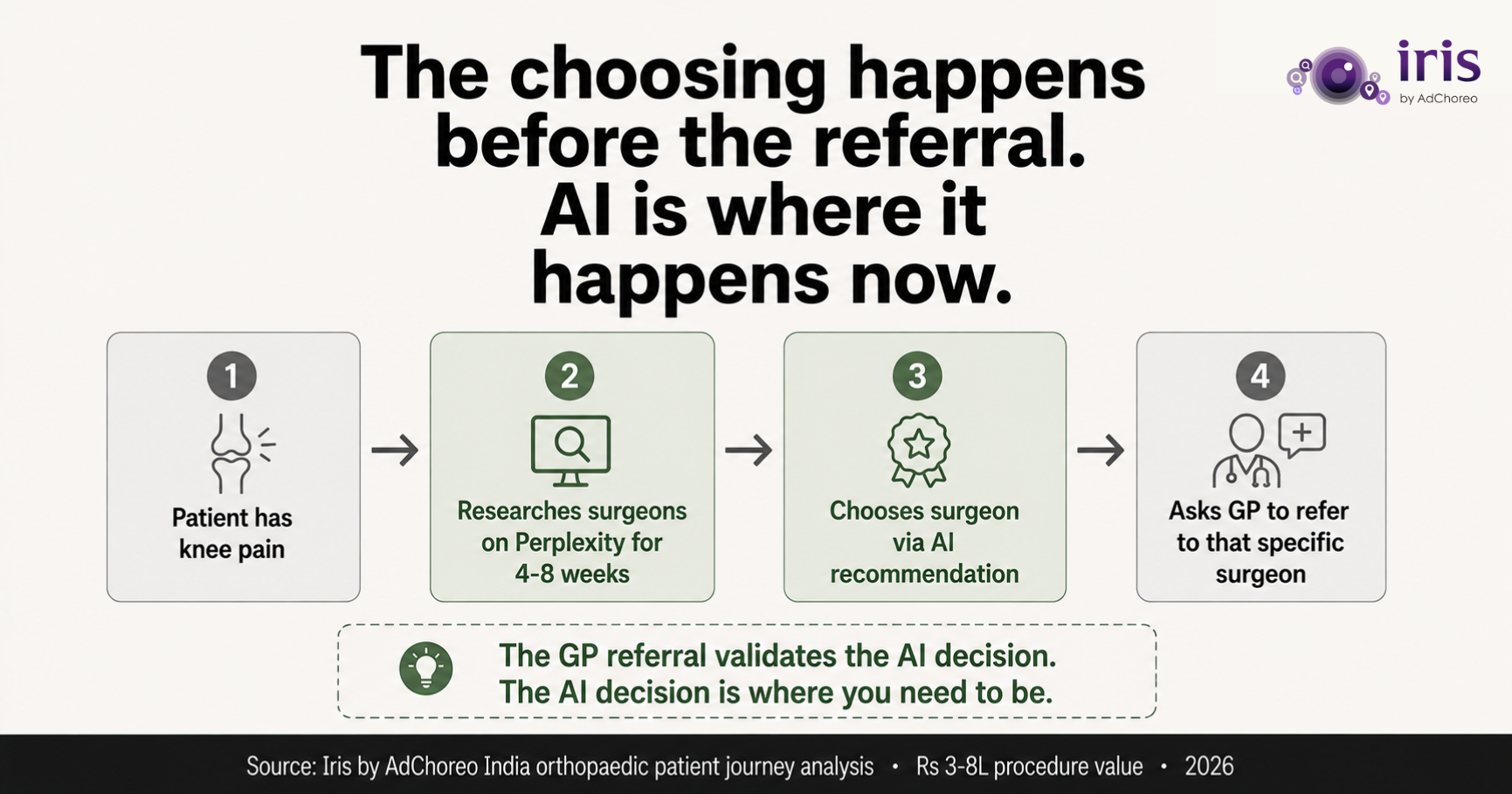
Rajan, 58, has had chronic knee pain for two years. His family physician has mentioned knee replacement as a possibility. Before his next GP appointment, Rajan spends three weeks on Perplexity researching. He asks: "What is the difference between total knee replacement and partial knee replacement?" "Who are the best knee replacement surgeons in Pune with experience in robotic surgery?" "What is the recovery timeline for knee replacement surgery in India?" "What should I ask a knee surgeon at my first consultation?"
By the time Rajan sits in his GP's office, he has already decided which orthopaedic surgeon he wants to be referred to. He tells his GP the surgeon's name. The GP writes the referral. The pre-referral AI research phase determined the outcome — and the GP referral was the administrative step that followed the AI-mediated decision.
This pattern is increasingly common in Indian orthopaedic patient journeys. Most orthopaedic practices are completely absent from it.
The AI queries are specific, clinical, and reveal the decision framework patients are applying. Understanding these queries is the content roadmap for orthopaedic AI visibility.
Procedure comparison queries: "Total knee replacement vs partial knee replacement — what are the differences and which is better for me?" "TPLO vs TTA for knee ligament repair in India." "Robotic knee replacement vs conventional — is it worth the additional cost?" These queries require comparison pages with direct opening answers and FAQPage schema.
Candidacy queries: "What age is too young for knee replacement surgery?" "I have a BMI of 34 — am I a candidate for hip replacement?" "Can I avoid knee replacement with physiotherapy if I have grade 4 osteoarthritis?" These require candidacy FAQ content with medical specificity.
Surgeon qualification queries: "What fellowship training should an orthopaedic surgeon have for complex knee replacement?" "Is robotic surgery for joints better if the surgeon has done 500+ procedures?" "How do I evaluate an orthopaedic surgeon's experience in India?" These require Person schema with surgeon credential data.
Recovery and outcome queries: "How long does knee replacement recovery take to get back to normal walking?" "What is the failure rate of knee replacement in India?" "How long does a knee implant last and when will I need revision surgery?" These require outcome FAQ pages with data-backed direct answers.
Pre-consultation preparation: "What questions should I ask an orthopaedic surgeon before agreeing to knee replacement?" "What investigations does the surgeon need before knee replacement?" These create an opportunity for pre-consultation checklist content that positions the practice as a transparent, patient-oriented provider.
Robotic joint replacement surgery is a rapidly growing category in Indian orthopaedics, with MAKO and other robotic systems being adopted by private hospitals and specialist practices across metros and Tier 2 cities. Patients are researching robotic surgery specifically — asking whether it produces better outcomes, costs more, has faster recovery, and which surgeons in their city are certified to perform it.
The robotic surgery page is one of the highest AI citation opportunities for an orthopaedic practice that has this capability. A page that opens with "Robotic-assisted knee replacement at [Clinic Name] uses the MAKO SmartRobotics system to plan and execute the procedure with sub-millimeter implant positioning accuracy. Dr. [Name] is one of [N] MAKO-certified orthopaedic surgeons in Pune and has performed over [X] robotic knee replacement procedures" gives the AI specific, verifiable data points — certification, procedure count, location specificity — that produce high-confidence citations for robotic surgery queries in that city.
Orthopaedic practice websites in India tend to fall into two content problems. The first: medically dense content written for GP referrers and medical professionals rather than for patients. Surgical technique descriptions in clinical language, procedure names in Latin, outcome data without patient-oriented context. AI systems struggle to extract patient-relevant direct answers from clinically dense content.
The second: brief, generic patient-facing content that avoids specificity. "We offer comprehensive knee and hip surgery with the latest techniques." This tells a patient AI nothing specific about the practice's capabilities, subspecialty focus, or surgeon credentials.
The AI-readable sweet spot is specific, patient-oriented, direct-answer content that opens with the answer the patient asked for and uses clinical terminology in a way that is accurate but not impenetrable. "A partial knee replacement — also called unicompartmental knee arthroplasty — is recommended when arthritis affects only one of the three compartments of the knee joint, preserving more bone and soft tissue than total knee replacement and typically allowing faster recovery" is both clinically accurate and directly extractable by AI for the "total vs partial knee replacement" query.
Free agentic readiness audit. Scored across all six AI visibility dimensions. No sales call required.
Run Your Free Audit → Over 1,000 independent clinics audited. Average score: 47 out of 100.