Mental HealthPsychiatryAI Search IndiaPsychology Clinics
Mental Health Clinics and Psychiatry Practices in India Are the Most AI-Invisible Healthcare Category. Here Is the Specific Reason Why.
A patient in Pune, 29 years old, has been experiencing panic attacks for six months. She has not told her family. She is not ready to call a psychiatrist. She opens ChatGPT on her phone at midnight and asks: "What is the difference between anxiety disorder and panic disorder?" Then: "Which type of therapy is most effective for panic attacks?" Then: "How do I find a good psychiatrist in Pune who specialises in anxiety?"
That third question is where she will find — or not find — your clinic. And the clinics that appear in ChatGPT's response to "how do I find a good psychiatrist in Pune who specialises in anxiety" are not necessarily the most experienced or the most empathetic. They are the ones with specific, AI-readable content about their anxiety specialisation.
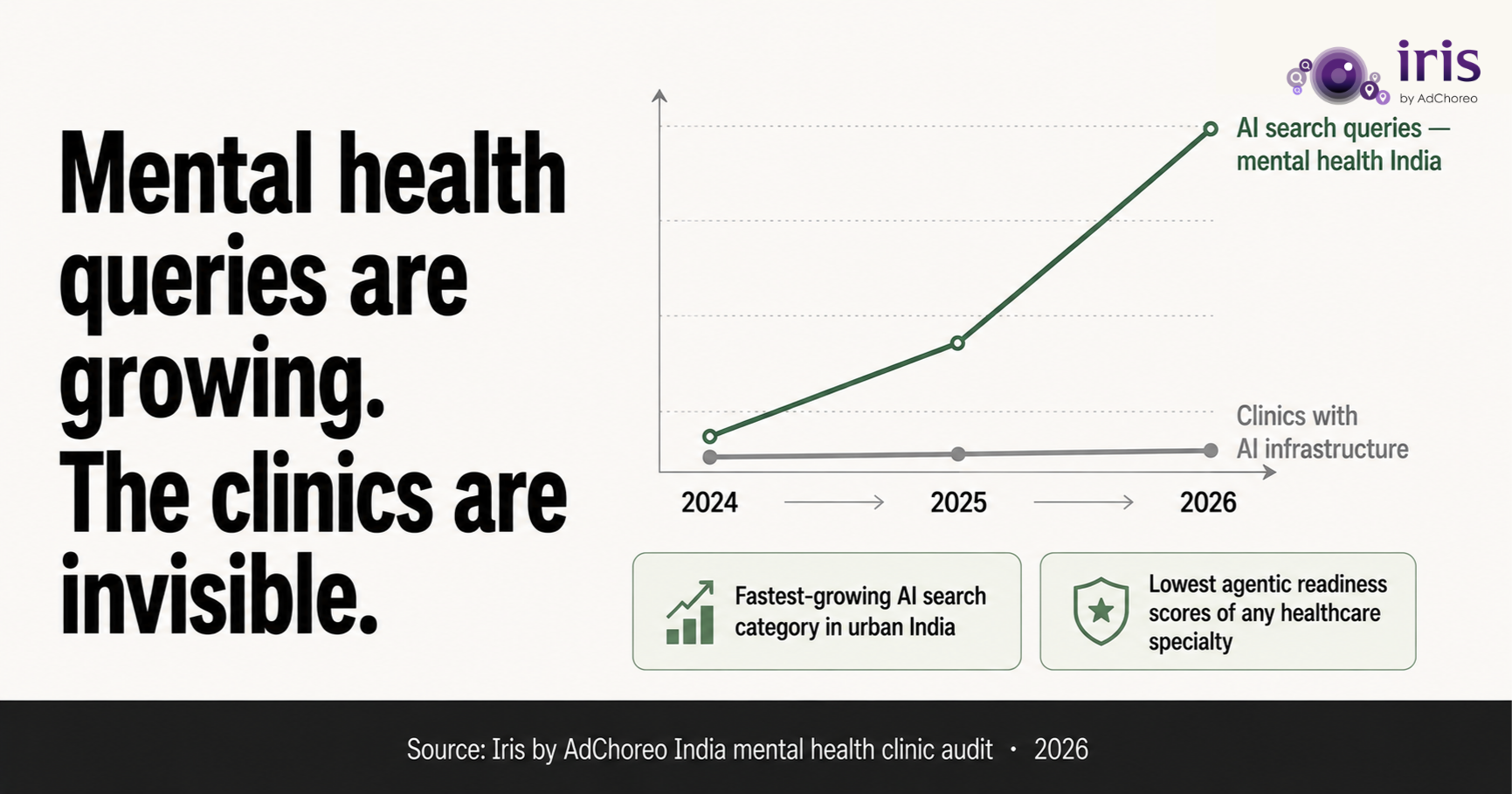
Mental health is the fastest-growing AI search category in Indian urban healthcare. It is also, by a significant margin, the most AI-invisible. The reasons are structural and specific to how mental health content is typically written in India — and they are fixable.
Mental health content in India faces a genuine tension that no other healthcare specialty faces as acutely: the need to be sensitive, non-stigmatising, and non-prescriptive, versus the AI search requirement to be specific, direct, and clinically grounded.
A well-written mental health clinic website will say things like: "We believe in a compassionate, holistic approach to mental wellness." "Our team of experienced professionals creates a safe, non-judgmental space for healing." "We understand that every patient's journey is unique." These sentences are appropriate — they address the emotional state of patients who may be seeking help for the first time and need to feel that the clinic is safe and welcoming.
But they are not AI-citable. An AI system that reads "we believe in a compassionate, holistic approach to mental wellness" cannot extract a direct answer to "which psychiatrist in Pune specialises in anxiety disorder and uses CBT?" It has no specific clinical information to work with.
The clinics that appear in AI responses for mental health queries are the ones that have specific, AI-extractable content alongside their empathetic framing: "Dr. [Name] specialises in the assessment and treatment of anxiety disorders, panic disorder, OCD, PTSD, and depression using evidence-based approaches including CBT, DBT, and mindfulness-based interventions." That sentence is directly citable. The empathetic framing can coexist with it on the same page.
Mental health AI search queries are distinctive: they are often phrased in the first person, they frequently combine symptoms with geography, and they carry implicit urgency that makes the first AI-cited response disproportionately influential.
"I think I have OCD — which therapist in Bengaluru can help me?" "What is the difference between a psychiatrist and a psychologist in India and which one should I see for depression?" "I've been having panic attacks for three months — do I need medication or therapy first?" "Which mental health clinic in Mumbai treats work burnout and is covered by corporate health insurance?"
Each of these queries has a specific information need. The clinic whose website contains specific, AI-extractable answers to these questions — structured as FAQ content with FAQPage schema — gets cited. Most mental health clinic websites in India have no specific content for any of these queries. They have general welcome copy, a team list, a services list with brief descriptions, and a contact form.
The principle is the same as in other specialties: inverted pyramid format, specific and directly extractable. The application requires care about sensitivity and stigma — but sensitivity and specificity can coexist.
A psychiatry practice FAQ page can contain:
"What is the difference between a psychiatrist and a psychologist?" Answer: "A psychiatrist is a medical doctor (MBBS with MD or DPM in Psychiatry) who can prescribe medication and provide psychotherapy. A psychologist holds a Masters or PhD in Psychology and provides psychotherapy without prescribing medication. For conditions that may require medication — depression, bipolar disorder, ADHD, schizophrenia — a psychiatrist is the appropriate first contact."
That answer is specific, clinical, directly extractable, and completely non-stigmatising. FAQPage schema applied to this content makes it a reliable AI citation source for one of the most searched mental health questions in India.
The FAQ library should cover: psychiatrist vs psychologist vs therapist; which conditions require medication; what a first appointment involves; how long therapy typically takes; confidentiality and whether family will be informed; whether the clinic handles corporate and insurance claims. Each answer, written in direct and specific language with the answer in the first sentence, feeds AI citation.
Many mental health clinics in India have their GBP listed as "Doctor," "Medical Clinic," or "Health Consultant" — categories that provide no specialty signal for AI Mode's local recommendations. The correct primary category for a psychiatry practice is "Psychiatrist." For a psychology practice or counselling centre: "Psychologist" or "Mental Health Service." For a holistic mental wellness centre: "Mental Health Clinic" is a more recent GBP category that is appropriate where the practice combines multiple modalities.
Secondary categories should reflect the specific specialisations the clinic treats: Anxiety, Depression, ADHD, OCD, Eating Disorder, Addiction, or the therapeutic modalities offered: CBT Therapist, DBT Therapy, EMDR Therapy. These secondary categories make the practice visible in AI Mode for specific condition and treatment queries.
Free agentic readiness audit. Scored across all six AI visibility dimensions. No sales call required.
Run Your Free Audit → Over 1,000 independent clinics audited. Average score: 47 out of 100.