AI Just Overtook the GP Referral as the #1 Way Patients Choose a Doctor. Here's What the Data Says.
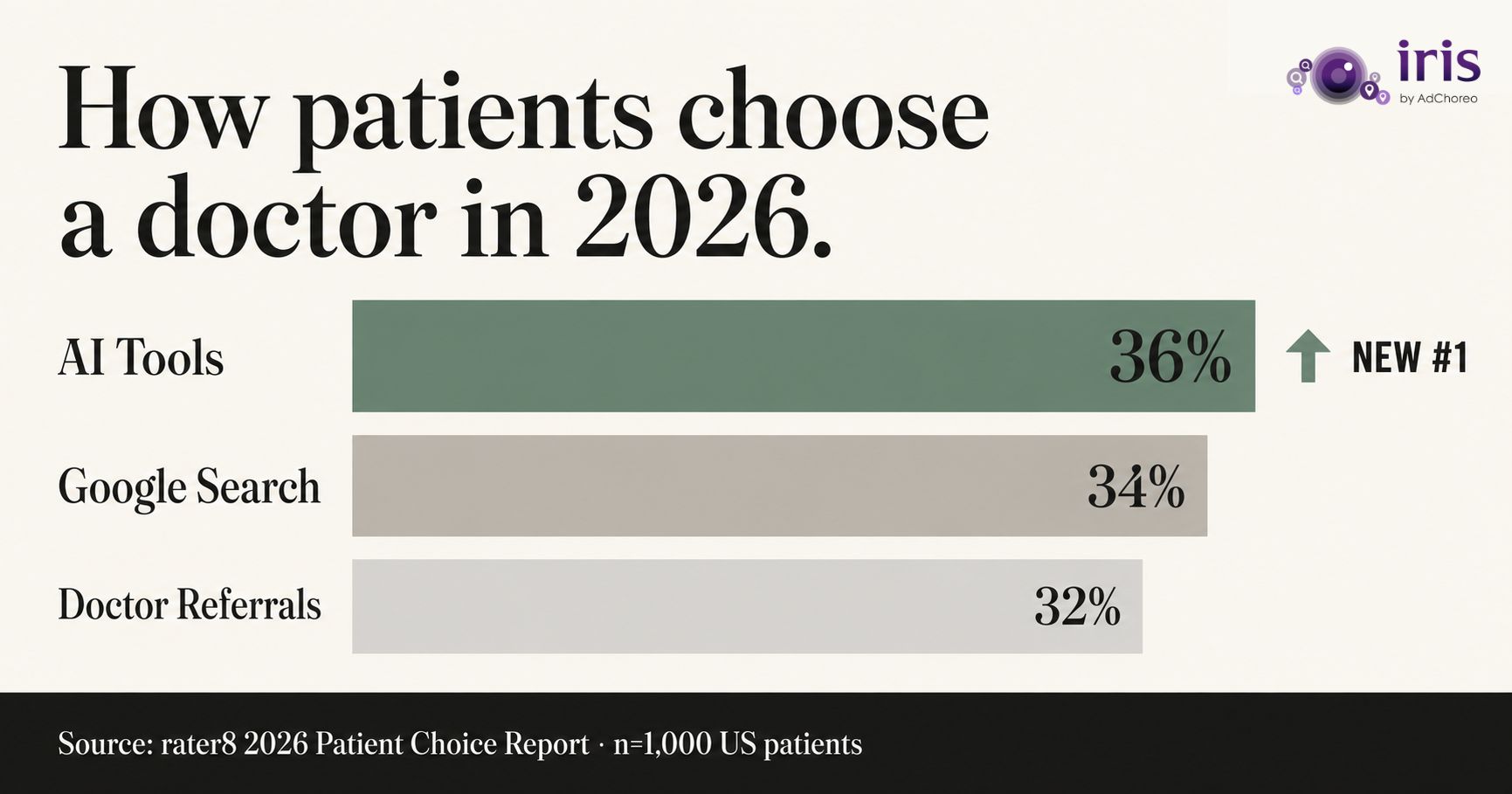
For decades, the GP referral was the most reliable source of new specialist patients for independent medical clinics. rater8's 2026 Patient Choice Report — published June 3, based on nearly 1,000 US patient surveys — just changed that. AI influence on provider selection (36%) has overtaken both traditional Google search (34%) and doctor referrals (32%) for the first time ever. If your clinic was built on referral relationships, this is the data point that changes your patient acquisition strategy.
Key Takeaways
- AI is now the #1 digital influence on provider selection at 36% — ahead of Google search (34%) and GP referrals (32%) for the first time.
- AI use doubled in 9 months — from 17% to 36%, faster than any previous patient discovery channel shift.
- 37% of patients trust AI Overviews most when researching a doctor on Google — ahead of organic links (20%) and the local map pack (13%).
- Patients aren't always choosing AI — most Google health searches now automatically trigger AI Overviews, so patients encounter them whether they seek them or not.
- The elective and self-referred patient segment is the most AI-influenced — exactly the highest-margin patients for most independent clinics.
- Even referred patients now research their referred provider via AI before attending — a poor AI presence can lose a referral you technically already won.
How Fast This Changed — And Why the Speed Matters
The velocity of this shift is as significant as the shift itself. Just nine months before the June 2026 report, the same AI influence metric sat at 17%. It doubled — to 36% — in under a year. That exceeds the planning and adaptation cycle of most independent clinics reviewing their marketing strategy annually.
The acceleration reflects a mechanism rater8 specifically flagged: patients are not always actively choosing to use AI. Most Google health searches now automatically trigger AI Overviews, so patients encounter AI-generated summaries whether they seek them out or not. The 37% who trust AI Overviews most aren't necessarily dedicated AI adopters — they're people who typed a healthcare query into Google, were shown an AI-generated summary at the top, and found it the most authoritative-looking result.
"Patients aren't necessarily choosing to use AI; rather it's being placed in front of them." — rater8, 2026 Patient Choice Report
What "AI Influence" Actually Covers
The 36% figure represents patients who said AI tools were a top digital influence in selecting a specific provider. It encompasses several distinct pathways — each with different infrastructure requirements:
- Direct ChatGPT/Perplexity queries — "best dermatologist in Pune" — routed through web browsing, schema markup, and llms.txt.
- Google AI Overviews — appearing automatically at the top of health searches, drawing from website content and GBP data.
- AI Mode local results — conversational provider discovery using GBP entity data and website-level schema.
- Voice assistant queries — "find a physio near me" — routed through Speakable schema and GBP proximity data.
These are distinct technical pathways. The 36% covers all of them. Which means a clinic that's only addressed one pathway is only partially visible to the most influential discovery channel in healthcare right now.
The 37% Who Trust AI Overviews Most — Why That Number Understates the Real Impact
When rater8 asked patients which section of Google they trust most when researching a doctor:
- AI Overviews: 37%
- Organic blue links: 20%
- Local map pack: 13%
- Sponsored results: 7%
But this understates the effective reach of AI Overviews. Patients who trust them most will disproportionately act on them. Meanwhile, the AI Overview has already shaped the frame of the search for every patient who saw it — regardless of what they clicked. The clinic cited in the AI Overview has been implicitly endorsed by Google's AI before the patient has evaluated a single individual result. AI Overview citation is now a higher-trust signal than a page-one organic ranking, for a meaningful plurality of patients.
What Happens to Clinics Still Running on Referrals
The GP referral remains valuable — 32% influence is not zero. But two implications stand out for referral-dependent clinics:
- Elective and self-referred patients — the highest-margin segment for most independent clinics — are making autonomous decisions without a GP directing them. They are exactly the demographic AI influence has captured most completely.
- Even referral patients now research before attending. A GP referral is no longer the end of acquisition — it's the beginning of an AI research process. A clinic absent from or misrepresented in AI Overviews loses some portion of its referred patients before those patients ever make contact.
The Infrastructure Behind the AI Influence Channel
There's no single lever to pull. Capturing the AI influence channel requires a stack of components, each covering a different patient discovery moment:
- Schema markup and AI-readable content — for AI Overview citation on clinical and procedure queries.
- GBP completeness and entity data — for AI Mode local recommendations.
- robots.txt + llms.txt — for ChatGPT and Perplexity accessibility.
- Speakable schema — for voice assistant queries.
- Review volume and recency — cross-referenced by AI systems as entity quality signals.
Clinics that haven't started building this infrastructure aren't just missing an opportunity — they're using patient acquisition tools built for a previous era, in a landscape that has structurally changed around them. The free Iris agentic readiness audit scores your clinic's AI visibility across all six dimensions in 60 seconds and shows precisely where the gaps are.