PractoAI Search IndiaPatient Discovery India
When a Patient Asks ChatGPT for the Best Dermatologist in Bengaluru, Practo Gets Cited. Your Clinic Doesn't Have To Accept That.
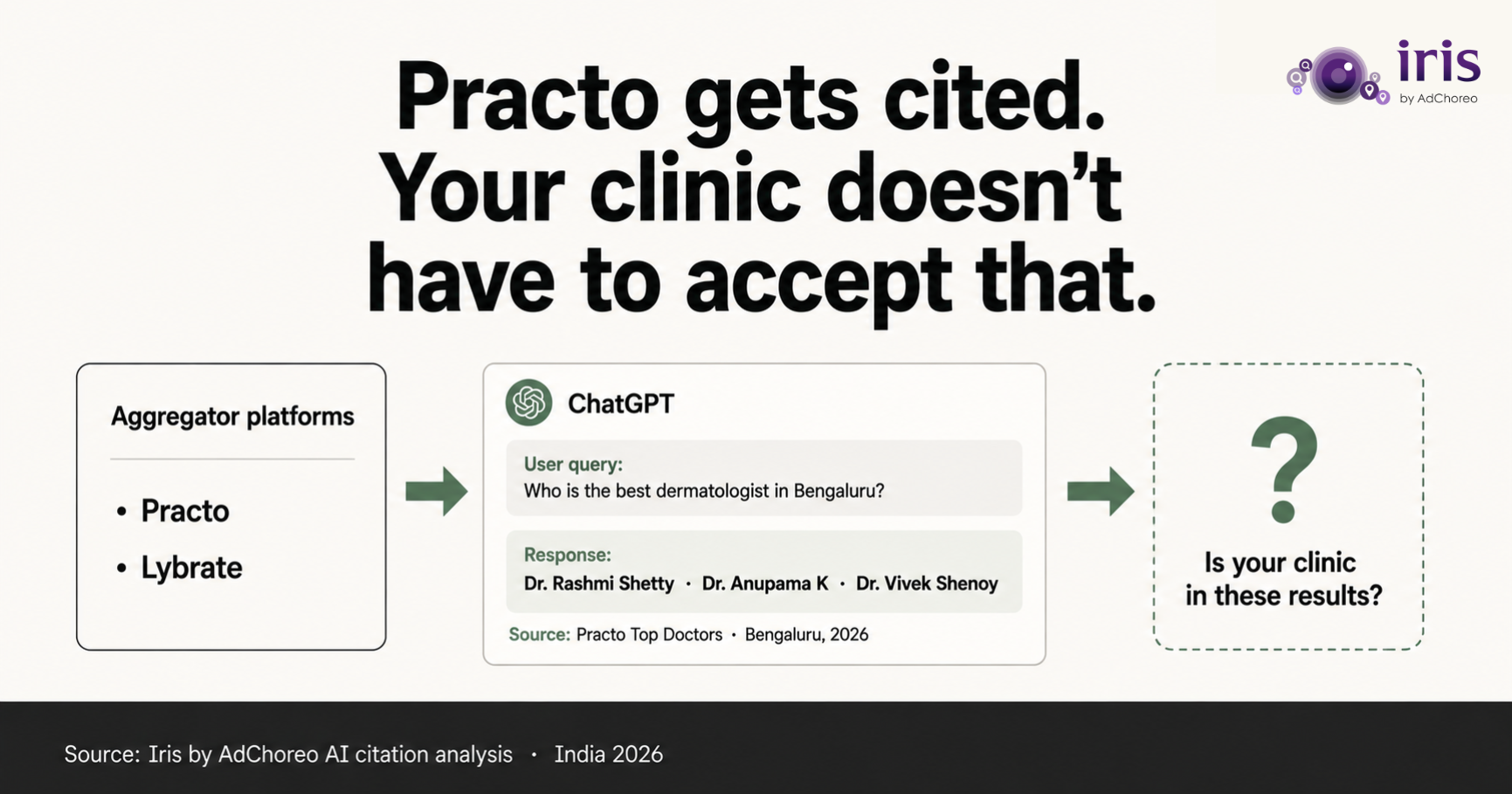
Open ChatGPT right now and type: "Who is the best dermatologist in Bengaluru?" or "Which IVF centre in Hyderabad has the best success rates?"
Read the response carefully. Note which sources are cited. In most cases, the response will cite Practo's Top Doctors pages, Lybrate's doctor listings, or Times Health features. It will name specific doctors — but those names were surfaced through aggregator platforms, not through the clinics' own websites.
This is a structural reality of how AI search works in India in 2026, and it represents a significant competitive dynamic that most independent clinic owners have not noticed yet. AI systems cite whatever indexed, authoritative-seeming source they can find about a topic. For specialist recommendations in Indian cities, Practo currently has more AI-readable, indexed content than almost any independent clinic website. So Practo gets cited.
The mechanism is straightforward and unsentimental. ChatGPT retrieves information from indexed web sources when a user asks a question. It is not evaluating clinical quality. It is not checking which doctor has the most years of experience. It is looking for structured, authoritative content that directly answers the patient's query.
Practo has built exactly that for thousands of Indian doctors. Practo's Top Doctors pages include: a doctor's name, specialty, years of experience, qualifications, clinic location, and patient review count — all presented in a structured, scannable format that AI crawlers can read and extract. The page title is "Top Dermatologists in Bengaluru" or "Best IVF Specialists in Hyderabad" — directly matching the patient's query. The page is indexed, internally linked, and has domain authority from millions of patient interactions.
Your clinic's website, by comparison, likely has: a home page with marketing prose, a services page that lists treatments without AI-readable structure, a team page with an unstructured doctor biography, and no schema markup formally identifying any of this as a medical entity with a specific specialty and location. From an AI crawler's perspective, your website is harder to read, less structured, and provides less directly answerable content than Practo's listing page about you.
So when a patient asks ChatGPT who the best dermatologist in Bengaluru is, ChatGPT cites Practo — because Practo is the highest-quality indexed source ChatGPT can find that directly answers the question. Your clinic's own website is not competing for that citation.
The cost of being cited through Practo rather than directly is multifaceted.
First, the citation equity accrues to Practo's domain, not yours. When ChatGPT cites "Practo.com/top-doctors/dermatologist/bengaluru" as the source for its recommendation, that citation increases Practo's authority as a health information source. It does nothing for your website's authority. The AI research that led the patient to your name benefited Practo.
Second, the patient's first action is to visit Practo, not your website. They see Practo's interface, with Practo's booking button, Practo's related doctor suggestions, and Practo's sponsored listings for clinics that pay for premium placement. Your clinic may appear on that page — but so do three or four competitors, some of whom pay for higher placement than you do.
Third, the patient relationship begins on Practo's terms. Their contact data, their search intent, their booking — all of this flows through Practo's system before it reaches your clinic. The consultation you receive is real. The intelligence about how the patient found you, what they searched, and what they compared remains with Practo.
The fix requires building the thing that ChatGPT currently finds missing on your website: structured, AI-readable content that directly answers the questions patients ask when searching for your specialty.
For a dermatology clinic, that means: a homepage that opens with "Dr. [Name] is a board-certified dermatologist in [locality], Bengaluru, specialising in acne, pigmentation, laser treatments, and cosmetic dermatology" — a direct, extractable sentence that AI can cite. MedicalBusiness schema with the practice type, specialty, address, and geo-coordinates. MedicalProcedure schema for each treatment. FAQPage schema on patient questions. A llms.txt file at the site root guiding AI crawlers to the most important pages. And a correctly configured GBP with "Dermatologist" as the primary category and treatment-specific service entries.
When this infrastructure is in place, ChatGPT has a direct, structured, authoritative source on your clinic's own domain that answers the question "who is the best dermatologist in [locality of Bengaluru]" more specifically and authoritatively than Practo's generic city-wide listing. AI systems prefer more specific, more authoritative sources. Your clinic's own page, correctly built, outcompetes a generic Practo directory page for locality-specific queries.
This does not require leaving Practo. It requires building on your own domain what Practo has built on theirs — structured, indexed, AI-readable content about your clinic and your specialists. Once you have it, AI systems begin citing your website directly rather than Practo's listing about you.
"When we built AI-readable infrastructure for a Bengaluru skin clinic — MedicalBusiness schema, FAQPage content, llms.txt — ChatGPT began citing the clinic's own website for dermatology queries in Koramangala within six weeks. The Practo citation for the same doctor still appeared, but the clinic's own page appeared alongside it and, for locality-specific queries, above it."
Iris by AdChoreo, engagement data 2026
There is a secondary reason Practo gets cited that is worth understanding. AI systems try to cite sources that appear credible and verifiable. A Practo page about a doctor includes: the doctor's name, a photo, their qualifications, their clinic's address, patient review counts, and years of experience. It is a structured, verifiable-seeming profile. An independent clinic website with an unstructured doctor bio, no credential markup, and no photo alt text provides far fewer verification signals.
Person schema — structured data that formally declares a physician's qualifications, fellowship training, board certifications, and clinic affiliation — is the on-domain equivalent of what Practo provides in its doctor profiles. A clinic website with Person schema for each practitioner gives AI systems the verification signals they need to cite the clinic directly with the same confidence they cite Practo.
Free agentic readiness audit. Scored across all six AI visibility dimensions. No sales call required.
Run Your Free Audit → Over 1,000 independent clinics audited. Average score: 47 out of 100.