Google AI Mode Can Now Book Beauty and Wellness Appointments Autonomously. Medical Clinics Are Next — Is Your Booking Page Ready?
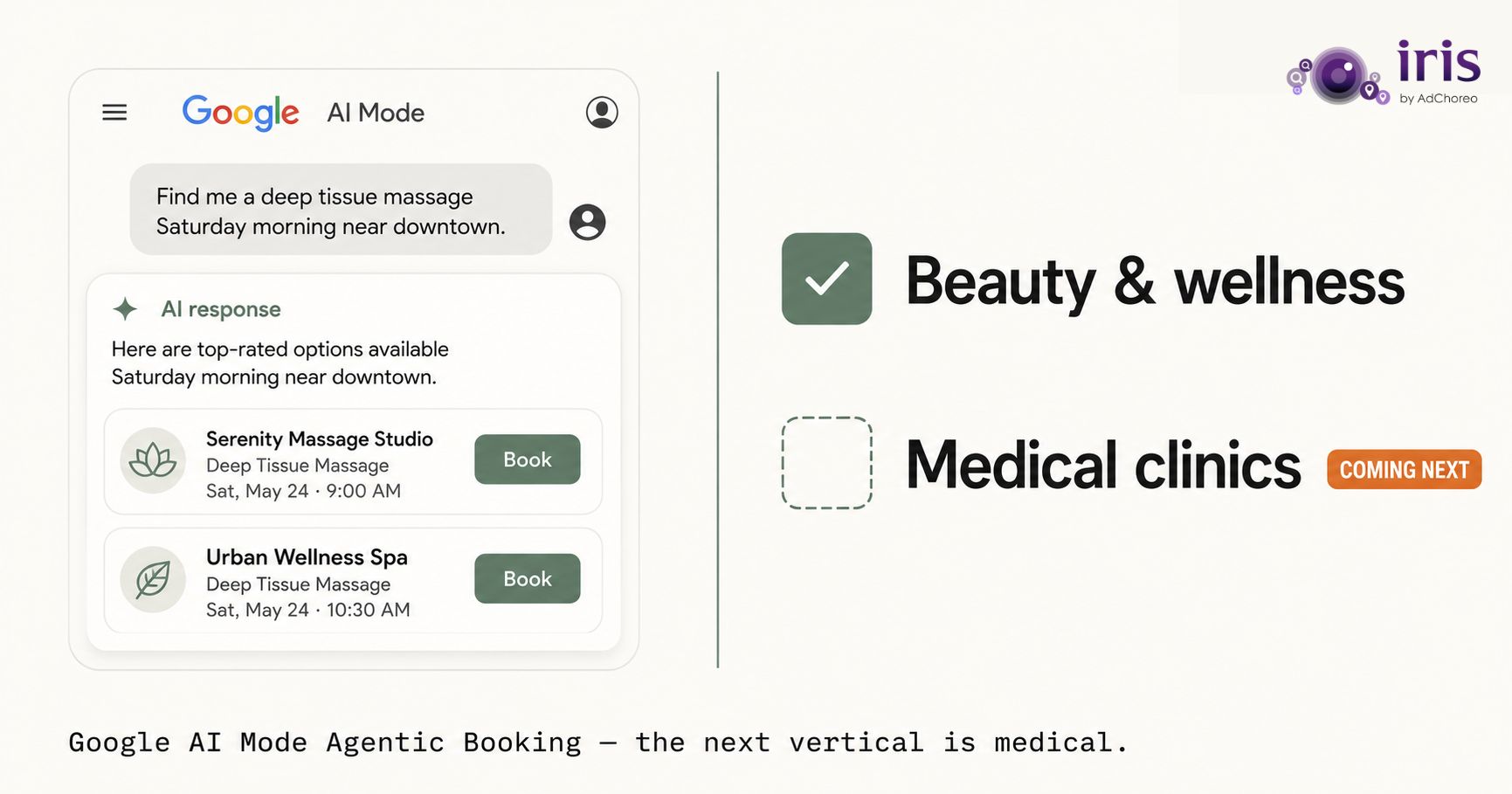
Google's AI Mode has been expanding its agentic booking capabilities in a methodical sequence that tells you exactly where healthcare is heading. It started with restaurant reservations in August 2025. It expanded to beauty and wellness appointments — spas, massage clinics, aesthetic wellness providers — in late 2025. A user can now ask "find me a deep tissue massage Saturday morning near downtown under ₹2,000" and AI Mode will autonomously search booking platforms, find matching availability, and present direct booking links. The patient never leaves Google. Medical and allied health is next in this sequence. The question is whether your clinic will be in those results when it arrives.
Key Takeaways
- AI Mode has moved from restaurants → wellness → medical in a methodical expansion of agentic booking capabilities.
- Two pathways into AI booking results: Reserve with Google integration on your GBP, or a booking platform with a Google-accessible API (like Booksy for wellness).
- JavaScript booking platforms are invisible to AI booking agents. Zenoti, Vagaro, and Boulevard render pages client-side — AI agents read HTML at request time and see an empty page.
- GBP service entry specificity is the matching input. "Botox, filler, chemical peel, laser hair removal" gets matched to patient preference queries. "Aesthetic Treatments" does not.
- This is infrastructure work, not a future concern. The clinics with booking infrastructure in place when the category expands will be included. The rest will be excluded.
How AI Mode's Agentic Booking Actually Works
Understanding the mechanism reveals exactly what makes a clinic bookable — or not. When a user asks AI Mode to find a wellness appointment, AI Mode dispatches an autonomous agent that searches across integrated booking platforms in real time. For beauty and wellness, this includes integrations with platforms like Booksy. The agent queries available slots matching stated preferences — date, time, location, service type, price — and assembles a curated response with specific options and direct booking links.
There are two ways a clinic's availability can surface in this process:
- Direct platform integration — if your clinic is on a platform (like Booksy) with a Google-integrated API, your real-time availability is queryable by AI Mode's booking agent.
- Reserve with Google — the GBP booking button integration feeds appointment availability directly into Google's systems, making it accessible to AI Mode agents for any clinic with it configured.
A clinic not on an integrated platform and without Reserve with Google configured cannot appear in AI Mode's agentic booking results, regardless of how good its SEO is, how many reviews it has, or how well-written its website content is. Agentic booking requires booking data availability — not just content discoverability.
The Specific Problem: JavaScript Booking Platforms
The majority of independent clinics in aesthetics, skin care, and wellness-adjacent medical specialties use JavaScript-rendered booking platforms — Zenoti, Vagaro, Boulevard, or in India, a Practo booking widget. These platforms render their booking interfaces client-side, meaning the booking page content is not present in the HTML when an AI agent first requests the page.
"AI booking agents read HTML at request time. They do not execute JavaScript, wait for dynamic rendering, and then re-read the content. A Vagaro or Zenoti booking page that says 'loading…' in raw HTML is, from an AI agent's perspective, an empty page." — Iris by AdChoreo, infrastructure analysis
This means a clinic using a JavaScript-rendered booking platform without a separate API integration or Reserve with Google configuration will be invisible to AI Mode's booking agents, even if it has built every other piece of AI visibility infrastructure correctly. The patient asks AI Mode to find a skincare appointment, AI Mode presents three bookable clinics — and the fourth, potentially the best in the market, isn't in the results because its booking page cannot be read.
What "Being Bookable by AI" Requires Right Now
Three practical steps you can take today that directly improve your readiness for AI agentic booking:
1. Configure Reserve with Google
Check whether your practice management software has a Reserve with Google partnership — many do, including several EHR and practice management platforms. Enabling this makes your appointment availability directly queryable by Google's systems, including AI Mode agents when the medical category expands.
2. Audit Your Booking Platform's AI Accessibility
If your primary booking platform is JavaScript-rendered and has no Google API integration, investigate whether a booking widget or secondary booking landing page can serve appointment availability in a format AI agents can read. This may not require replacing your booking platform — it may require adding a server-rendered entry point.
3. Make Your GBP Service Entries Specific
AI Mode's booking agent matches user preference queries against available service descriptions. A GBP with generic entries will match fewer patient queries than one with specific entries. Compare:
- Generic (won't match): "Aesthetic Treatments", "Skin Services"
- Specific (will match): Botox, Dermal Filler, Chemical Peel, Laser Hair Removal, PRP Hair Treatment, HydraFacial — each with appointment duration and pricing
The Timing Question
Google's agentic booking expansion moved from restaurants to beauty and wellness in approximately three months. The natural next categories are medical and allied health — physiotherapy, chiropractic, dental hygiene, optometry, and aesthetic medicine specialties that overlap with the wellness category already covered. Several are already adjacent to the current "wellness" category.
The clinics with booking infrastructure configured when the capability arrives will be included in AI-curated booking results. The clinics still on opaque JavaScript booking pages with unconfigured Reserve with Google will experience the same exclusion from agentic booking that many currently experience from AI recommendations — invisible, silent, and compounding. The free Iris agentic readiness audit includes booking infrastructure in its six-dimension assessment — start there to understand where you stand.