AyurvedaAI Search IndiaWellness Clinics
Your Panchakarma Centre Has Treated Thousands of Patients. ChatGPT Has Never Heard of It.
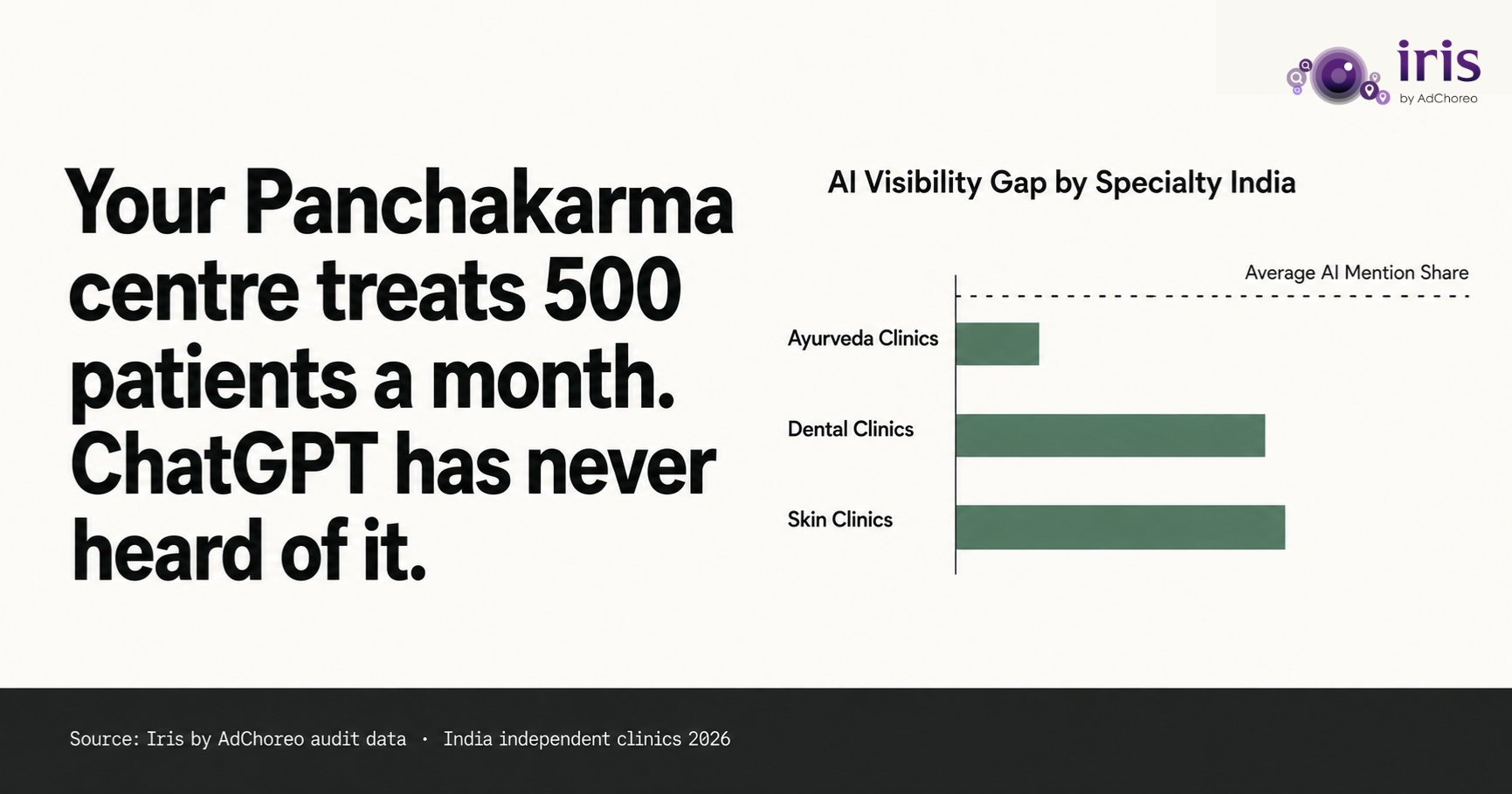
Your Panchakarma centre may have been practising for three decades. It may have patient testimonials going back to 1994. It may be the most trusted Ayurveda institution in your neighbourhood. And when a patient in Bengaluru opens ChatGPT and asks "which is the best Panchakarma centre near Koramangala for stress and chronic back pain," none of that matters — because ChatGPT cannot read reputation. It reads infrastructure.
AI systems construct their recommendations from structured, machine-readable data: schema markup that formally identifies your centre as a health business, llms.txt files that guide AI crawlers to your most important content, and Google Business Profile data with correctly configured categories. Most Ayurveda and Panchakarma centres in India have none of these. The result is invisibility — not because the practice lacks quality, but because the quality has never been expressed in the language AI systems read.
Ayurveda has a terminology challenge that no other healthcare specialty in India faces. The treatments — Shirodhara, Abhyanga, Navarakizhi, Udvartana, Basti, Pizhichil — are precise clinical terms with deep meaning within the tradition. They are also, from an AI system's perspective, opaque strings with no semantic mapping to the conversational queries patients actually use.
When a patient in Pune asks ChatGPT "what Ayurvedic treatment is good for stress and insomnia," the AI searches for content that opens with a direct answer to that specific question. A webpage on Shirodhara that begins with "Shirodhara is a traditional Ayurvedic treatment rooted in the Charaka Samhita, involving a continuous stream of medicated oil..." is not what the AI can extract a quick, citeable answer from. A webpage that begins with "Shirodhara is an Ayurvedic treatment where warm medicated oil is poured continuously over the forehead for 30-60 minutes, clinically indicated for stress, insomnia, anxiety, and migraine headaches" — that opening sentence is directly citeable.
The fix is not abandoning Sanskrit terminology. It is writing content that opens with the extractable answer and then uses classical terminology as contextual enrichment. The AI reads the first sentence. Patients who arrive from that AI citation then read the rest.
Google Business Profile powers Google Maps visibility and Google AI Mode's local recommendations. The primary category on a GBP profile is one of the highest-impact signals in AI Mode's recommendation logic — it determines which patient queries your centre is eligible to appear for.
Most Ayurveda centres in India have their GBP listed as "Health" or "Alternative Medicine Practitioner" — generic categories that AI Mode cannot map to specific queries like "Panchakarma centre near me," "Ayurvedic treatment for arthritis in [city]," or "Kerala Ayurveda centre in Bengaluru." The correct primary category is Ayurvedic Clinic, with secondary categories for Wellness Center, Alternative Medicine Practitioner, and specific treatment types.
This single correction — changing the GBP primary category and adding treatment-specific service entries — is often the highest single-action change available to an Ayurveda centre. It takes 15 minutes to implement and materially improves AI Mode visibility for specialty-specific queries.
Ayurveda centres benefit disproportionately from voice search because the patient queries are proximity-driven and conversational — exactly the conditions where voice search dominates. A patient whose GP mentioned Panchakarma as a treatment option for chronic stress asks Siri on the drive home. A patient whose mother recommended Abhyanga for joint pain asks Google Assistant before calling anyone. These are not patients with settled opinions — they are in the research phase, and the first clinic that voice search names to them has a significant first-impression advantage.
The infrastructure required for voice search visibility is specific. Speakable schema applied to your centre's opening description and FAQ answers tells voice assistants which content to read aloud. LocalBusiness schema with geo-coordinates confirms your centre's proximity to the patient's location. Without both, Siri defaults to reading only your centre's name and address — no description of treatments, no reason for the patient to choose you over the next listing.
Fewer than 2% of Ayurveda and wellness centres in any Indian market have Speakable schema configured. This is, simultaneously, a problem and an opportunity. The first centre in your city and specialty to implement it becomes the voice search incumbent for Panchakarma and Ayurvedic treatment queries in your geography. There is currently no one to displace.
Building AI visibility for an Ayurveda or Panchakarma centre does not require abandoning your traditional positioning or rebuilding your website. It requires adding a structured data layer on top of what already exists.
The schema layer starts with LocalBusiness or HealthAndBeautyBusiness schema identifying the centre's entity type, address, and geo-coordinates. Individual MedicalProcedure schema entries for each treatment — Panchakarma, Abhyanga, Shirodhara, Basti, Navarakizhi, and others — with indication fields describing which conditions each treatment addresses. FAQPage schema applied to patient questions about treatment duration, candidacy, costs, and preparation. Speakable schema applied to your centre's description and treatment FAQs. And an llms.txt file at your website root guiding AI crawlers directly to your treatment pages and FAQ content.
The content layer requires treatment description pages written in the inverted pyramid format — opening with a direct, standalone answer that AI can extract, followed by clinical context and classical detail. The FAQ content should address the questions patients actually ask before booking: "How many days does a Panchakarma programme take?", "What should I avoid before an Abhyanga massage?", "Is Shirodhara safe for high blood pressure?", "What is the difference between Kerala Panchakarma and general Ayurveda treatment?"
None of this replaces the depth of your tradition. It translates it into the language AI systems understand.
Free agentic readiness audit. Scored across all six AI visibility dimensions. No sales call required.
Run Your Free Audit → Over 1,000 independent clinics audited. Average score: 47 out of 100.