India Market AnalysisAI Search StrategyCity-Specific Data
Your City's Hospital Chain Density Sets Your AI Ceiling. Independent Clinic AI Mention Share Varies 3x Across Indian Metros.
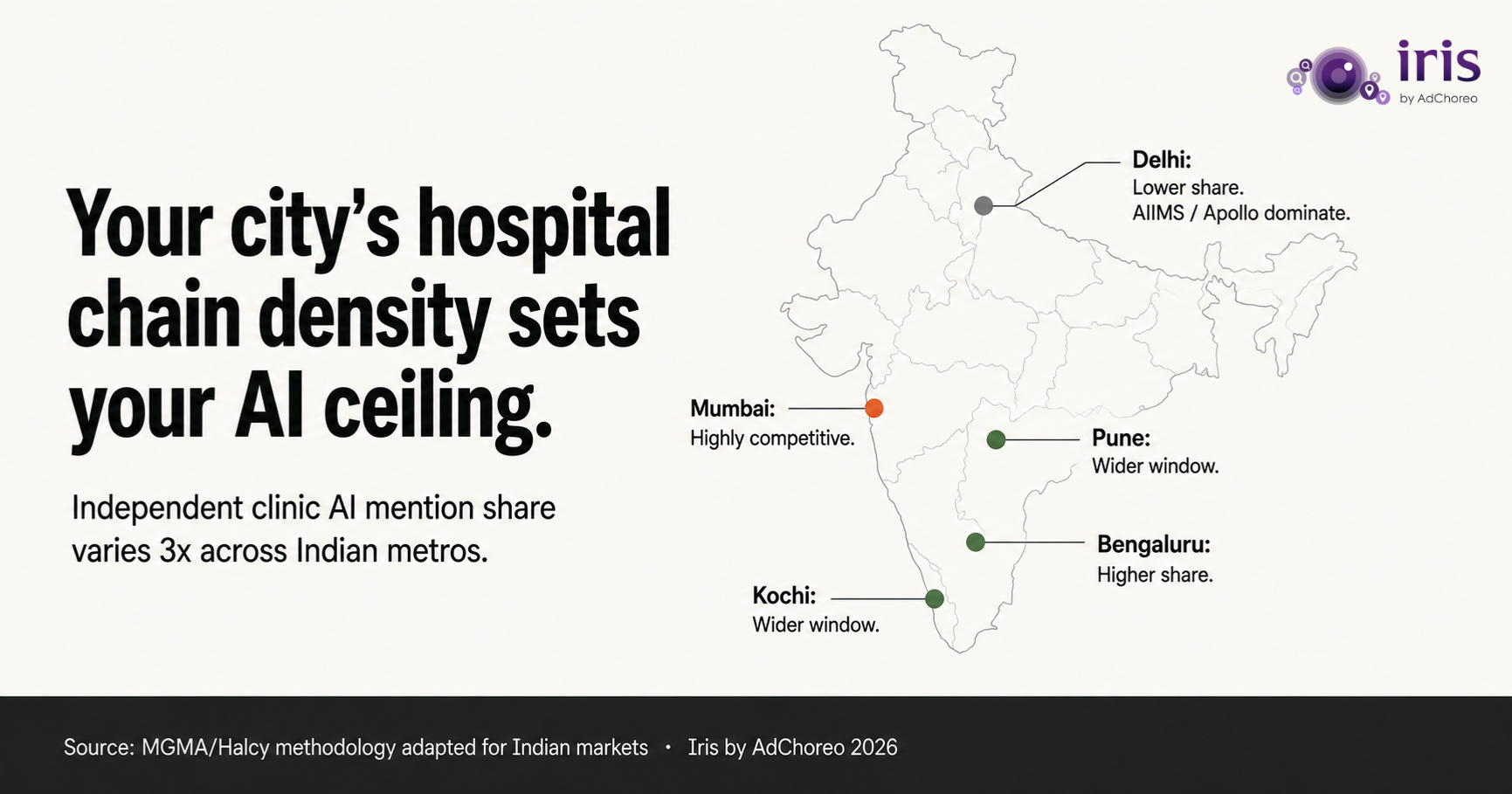
AI visibility is not equally accessible to independent clinics across all Indian cities. The structural factor that most determines how far an independent clinic can realistically expect to grow its AI mention share — the share of AI-generated local provider recommendations that cite the clinic — is the hospital chain density in its city. In markets where hospital chains dominate the healthcare landscape, they also dominate the AI-generated recommendations. In markets where independent practitioners have historically been the primary care providers, the AI opportunity is structurally larger.
This is not an abstract analysis. It determines how urgently an independent clinic in each city should be building AI visibility infrastructure — and how durable the first-mover advantage is once built.
Hospital chains have structural AI visibility advantages that individual independent clinics lack. A hospital chain like Apollo, Max Healthcare, or Manipal has: a nationally recognised brand entity that AI systems have extensive training data on; multiple verified GBP listings with consistent NAP data across all locations; dedicated digital marketing teams deploying schema markup and AI visibility infrastructure; published clinical data, accreditation documentation, and institutional authority signals; and media coverage and Wikipedia presence that reinforces entity authority.
When a patient in Delhi asks ChatGPT "who is the best cardiologist near me," the AI has abundant structured, authoritative data on AIIMS, Apollo, and Fortis — and relatively little structured data on the independent cardiologist practising in Lajpat Nagar whose website has no schema markup and whose GBP has not been updated in 18 months. The gap in AI infrastructure is real, and in high hospital-chain-density markets, it takes more investment and more time to close.
In markets where hospital chains are less dominant — Bengaluru's specialist ecosystem, Pune's growing healthcare market, Kochi's independent practitioner culture — the structural gap is smaller and the first-mover advantage for an independent clinic that builds AI infrastructure is more durable.
Delhi is the most challenging Indian market for independent clinic AI visibility, and the reason is structural rather than competitive. AIIMS is the highest-authority medical institution in India from an AI entity recognition perspective — it appears in training data for virtually every AI system in widespread use. Apollo and Fortis have invested significantly in digital infrastructure including schema markup, AI-readable content, and GBP management.
An independent dermatologist in Lajpat Nagar or an IVF clinic in Dwarka is competing for AI mention share against institutions with nationally recognised entity authority and dedicated AI infrastructure teams. That does not make AI visibility impossible — it makes it a longer, more investment-intensive build, and means the realistic AI mention share ceiling for an independent clinic in Delhi is lower than in less institutionally saturated markets.
For independent clinic owners in Delhi, the strategic implication is that AI visibility should be built, but the expectation of becoming the default AI-recommended provider in the city for a given specialty is less realistic than in Bengaluru or Pune. More achievable, and equally valuable, is becoming the default AI recommendation in a specific locality — the best dermatologist in South Delhi for a specific condition, the most visible IVF specialist in Dwarka, the first physiotherapist in Vasant Kunj to appear in voice search results.
Bengaluru's healthcare market has characteristics that structurally favour independent clinic AI visibility. The city's hospital chain penetration is lower relative to total specialist demand than Delhi or Mumbai. The tech workforce patient base is heavily concentrated in areas where independent specialist practices dominate — Koramangala, Indiranagar, Whitefield, HSR Layout — and these patients are AI-native healthcare searchers who use ChatGPT, Perplexity, and Google AI Mode before making provider decisions.
An independent skin clinic in Koramangala, a LASIK surgeon in Indiranagar, or an IVF specialist in JP Nagar building AI visibility infrastructure in mid-2026 is operating in a market where hospital chain AI competition is less intense than in Delhi and where the patient base is more likely to use AI search than in smaller markets. The compounding returns from early AI infrastructure investment are larger in Bengaluru than in most other Indian cities.
Pune and Kochi represent the widest AI visibility opportunity for independent clinics in India right now. Both cities have lower hospital chain density than the major metros. Both have growing urban patient populations with increasing AI search behaviour. And in both cities, the AI visibility infrastructure among independent clinics is essentially absent — the competitive window is not just open, it is uncontested.
A skin clinic in Viman Nagar, Pune, an IVF centre in Kothrud, or a physiotherapy practice in Ernakulam, Kochi, that builds AI visibility infrastructure in the second half of 2026 is not entering a competitive field. It is creating one — establishing the baseline that all future entrants will have to displace rather than simply claim. The first-mover advantage in these markets, once built, is likely to be durable for longer than in the more saturated metros.
Mumbai sits between the high-density challenge of Delhi and the open windows of Pune and Kochi. The city has significant hospital chain presence — Lilavati, Hinduja, Kokilaben — but also has one of the largest independent specialist ecosystems in India. The Glam Korean Skin Studio case, a new skin clinic in Andheri West, achieved Google AI Overview citations within three days of site launch with zero prior digital presence. That result is not a metropolitan anomaly — it reflects how open the AI visibility window remains in Mumbai's non-hospital-chain geographies.
The strategic read for Mumbai independent clinics is locality-specific. In South Mumbai and Bandra, hospital chain competition for AI visibility is higher. In Andheri, Goregaon, Malad, and Thane, the competitive window for independent clinics is significantly wider. An independent specialist in these localities building AI infrastructure in 2026 is competing against a much smaller field of AI-visible incumbents than a comparable specialist in South Mumbai or near a major hospital campus.
Free agentic readiness audit. Scored across all six AI visibility dimensions. No sales call required.
Run Your Free Audit → Over 1,000 independent clinics audited. Average score: 47 out of 100.